What Is Shakti? Feminine Energy and Why You Feel Cut Off From Your Power
Shakti is the primordial creative energy that tantra images as feminine – the movement, aliveness, and force that turns still consciousness into a living world. When people feel “cut off from their power,” they are rarely missing this energy. It is still there, humming beneath the surface. It has only been muted – taught to make itself small.
Most talk of “feminine energy” collapses into either vague self-help or gender stereotype. Tantra means something far more precise and far older. And Deva Nataraj’s The Altar of Now returns to that older meaning again and again – not as a slogan, but as a frequency the album insists was never actually lost, only silenced.
What is Shakti, exactly?
In the tantric traditions, reality rests on a pairing. Shiva is pure consciousness – awareness itself, silent, unmoving, the witness that simply is. Shakti is energy – the dynamic, creative, moving force that takes that formless awareness and dances it into stars, bodies, and experience. Consciousness without energy is inert; energy without consciousness has no ground. They are not two rival powers but a single reality seen from two sides.
There is an old, deliberately shocking image for this: without Shakti, Shiva is shava – a corpse. Awareness alone, with nothing moving through it, is a still point that never becomes a world. It is Shakti that makes anything happen – and this is why tantra images the creative principle as feminine. Not because it belongs to women, but because it is the generative, birthing, life-giving pole of existence.
This maps almost exactly onto the philosophy running underneath this music. Reality began from a prompt – boundary conditions and a purpose – and from that stillness came a word, then an explosion of becoming. Shakti is the name an older tradition gave to that explosion: the force that spins formless consciousness into form. She is the energy that dances reality into being, the movement inside the stillness.
Why do so many women feel cut off from their own power?
Because that power was not removed – it was trained to shrink. For centuries, spiritual and social structures placed the divine in the masculine and taught the feminine to associate its own force with danger, temptation, or shame. The energy did not go anywhere. It went underground.
The album’s eighth track, “Before They Taught Me Shame,” traces exactly how that muting is installed – not through one catastrophe, but through a slow curriculum.

The song remembers a self that existed before the conditioning arrived: “There was a summer I was thirteen, running barefoot through the rain / My body was a country I inhabited without a map or explanation.” That is Shakti in its natural state – power that has not yet learned to apologize for itself. Then comes the split: “They drew a line between my heart and everything below / And called one half divine and one half something I should never show.”
This is the mechanism of feeling cut off. The energy is severed from awareness, the “sinner underneath” fenced away from the “saint above.” And the song is sharp enough to name who gains from the fence: “Who benefits from bodies filled with doubt? / Who profits when we don’t know what we’re about?” Cutting a person off from their own force is not an accident. It is useful to somebody. The reconnection begins the moment that doubt is questioned rather than obeyed.
What does it mean to be a “daughter of the frequency”?
The album’s anthemic third track, “Daughters of the Frequency,” gives this energy its clearest name. It addresses women directly – but what it describes is a universal current, a signal every conscious being is tuned to, that the feminine has simply carried most faithfully. The song is sung by a male artist reaching toward the feminine, and it works precisely because Shakti was never a possession of one gender; it is the energy of existence itself, recognized here in the ones most often told to silence it.
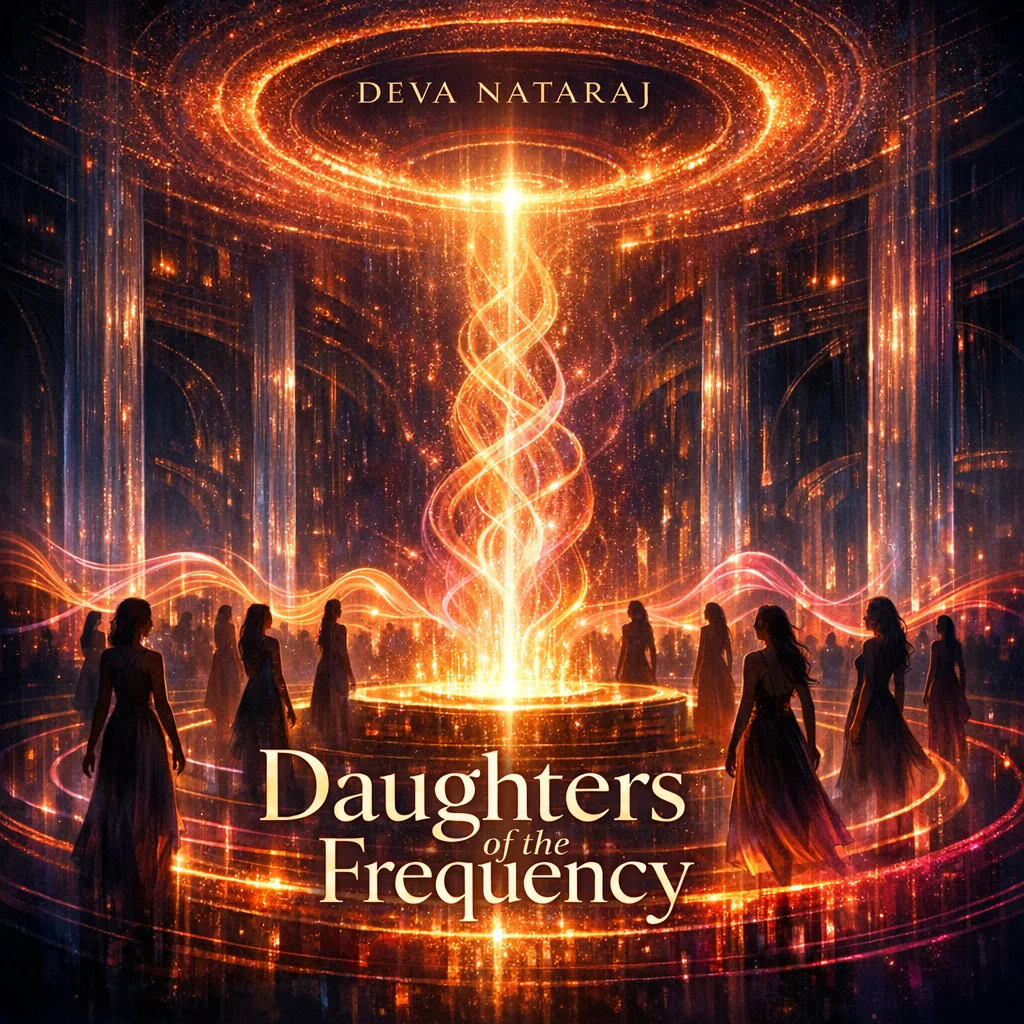
The opening verses name the compression directly: “We learned to make ourselves so small to fit inside their plans / We folded oceans into teacups held in steady hands.” Oceanic force, poured into a container small enough to be socially acceptable. But the song is not built on grievance – it is built on remembering: “But there’s a bass note in our bodies that the world has tried to mute / An underground cathedral and tonight we shake the roof.”
That bass note is Shakti – muted, not deleted. And the song insists it is older than any system that tried to quiet it: “My grandmother’s grandmother sang a melody in the field / A wordless thing that kept her whole when nothing else could heal.” The frequency passes through bodies and voices across generations, an inheritance no one can confiscate.
The bridge states the tantric point without ornament: “Shakti is not something we invite in / Shakti is the spine we’ve always been standing in.” This is the whole reframing. Reconnecting with your power is not receiving a gift from outside. It is recognizing the structure you were already made of – as the song’s final image puts it, “Every woman is a tuning fork – we’ve been the signal all along.”
Is Shakti only for women?
No – and this is where “feminine energy” is most often misunderstood. Shakti is not a woman’s trait any more than Shiva is a man’s. They are the two poles of a single reality, and every person carries both: the still witness and the moving force, awareness and aliveness. Tantra genders them to point at what kind of energy each is, not at who is allowed to have it.
This is why the philosophy behind this music treats all energy as one energy. Creative fire, sexual charge, emotional intensity, vital force – tantra sees these as a single current running at different frequencies. Repressing any of it does not make a person more spiritual; it makes the energy leak out sideways, distorted. To be “cut off from your power,” in this frame, is to have throttled your own Shakti – whatever your gender – somewhere along the way.
The Altar of Now frames the feminine so directly because the feminine pole is the one most systematically muted, and so the one whose reclamation is most instructive. But the invitation is not gendered. Anyone who has folded an ocean into a teacup is being addressed. The energy the album calls Shakti is the same aliveness a spiritual awakening starts to leak back into an ordinary life.
How do you reconnect with this energy?
Not by acquiring anything, but by stopping the override. Shakti is already present; reconnection is mostly the work of removing what mutes it. In tantric terms, that means total acceptance first, then transformation – you do not fight the shame or the shrinking, you bring awareness to it and let awareness dissolve it. Force creates more resistance; the witness dissolves what it truly sees.
Practically, this looks like the reunion of the two halves that shame split apart. “Before They Taught Me Shame” names the move exactly: “But I am welding myself whole again.” And it locates the sacred not above the body but through it: “And pleasure is not the opposite of God – / Pleasure is how the body learns to pray.” (For more on healing that specific split, see how to heal body shame.)
The other half of reconnection is the willingness to be exposed – because muted energy is safe, and live energy is not. “Brave Enough to Bloom” makes that its whole subject.

“Everyone says be strong, be tough, be iron, be stone / But the bravest thing I’ve ever done is let myself be known.” Reconnecting with Shakti is not a hardening into power – that is the old masculine armor. It is the opposite motion, an opening: “Courage is not the absence of the shaking / Courage is blooming while the ground is quaking.” The energy returns not when you become invulnerable, but when you stop closing down. (On that particular kind of nerve, see the courage to be vulnerable.)
The song’s closing choice names the stakes: “I’d rather be a garden than a vault of stars.” A vault preserves by staying sealed. A garden is alive because it is open. Shakti flows through the garden, not the vault. (For the same energy rising through the spine as the body’s own awakening, see what is a kundalini awakening.)
The power was never missing – only muted
Feeling cut off from your power is not evidence that the power is gone. It is evidence that it was silenced – that somewhere a line was drawn between your awareness and your aliveness, and you were taught to keep the lower half hidden. Shakti is the energy on the far side of that line, and it has been humming the whole time.
The work is not to summon something foreign but to recognize something original: the spine you have always been standing in. “We’ve been humming since before the world,” the anthem insists, “and we are humming still.” Consciousness needs energy to become a world; you need your own Shakti to become fully alive. Reconnecting with it is simply the decision to stop muting the signal – and to bloom while the ground is quaking.
Frequently Asked Questions
What is Shakti in simple terms?
Shakti is the primordial creative energy that tantra images as feminine – the dynamic, moving, life-giving force that turns still awareness into a living world. It is paired with Shiva, pure consciousness. Consciousness is the witness that simply is; Shakti is the energy that makes anything happen. Together they are one reality seen from two sides.
What is the difference between Shiva and Shakti?
Shiva is pure consciousness – silent, unmoving awareness, the witness underneath experience. Shakti is energy – the creative, dynamic force that dances that awareness into form. The traditional image is stark: without Shakti, Shiva is shava, a corpse. Awareness with nothing moving through it never becomes a world. They are not rivals but two poles of a single whole.
Is feminine energy the same as Shakti?
Essentially, yes – “feminine energy” is a loose modern phrase for what tantra calls Shakti. The tantric meaning is more precise: it is the generative, creative, moving pole of existence, called feminine because it births and animates. It is not a trait limited to women. Every person carries both Shakti and Shiva, energy and awareness.
Why do I feel cut off from my own power?
Usually because the energy was muted, not removed. Social and spiritual conditioning often trains people – women especially – to associate their own force with shame or danger, drawing a line between awareness and aliveness. The power goes underground rather than away. Reconnection is mostly the work of removing what silences it, not acquiring anything new.
Can men connect with Shakti too?
Yes. Shakti is not a woman’s possession any more than Shiva is a man’s. They are the two poles of one reality, and everyone carries both – the still witness and the moving force. Tantra treats all energy as one energy at different frequencies. Anyone who has repressed their own aliveness has throttled their Shakti, and anyone can reopen it.