Witness Consciousness: The Observer Within the Music
The Observer Behind Your Eyes
Close your eyes for a moment and notice something: you can observe your own thoughts. There is a part of you that watches the mind think, watches emotions rise and fall, watches the body breathe. This observer – the one who is aware of experience without being consumed by it – is what Eastern philosophy calls the witness.
In Advaita Vedanta, the witness (sakshi) is the unchanging awareness behind all experience. In Buddhism, mindfulness practice cultivates this witnessing capacity. In the Zen tradition, the question “Who is the one who hears?” points directly at this mystery. The witness is not something you need to develop or achieve. It is what you already are, beneath every thought, every emotion, and every identity you have ever assumed.
But for most of us, the witness remains hidden – drowned out by the constant noise of reactivity, narrative, and identification. We believe we are our anger, our anxiety, our achievements. We live in a state of perpetual entanglement with the contents of consciousness rather than recognizing ourselves as consciousness itself.
Deva Nataraj’s music returns to this theme again and again, approaching it from different angles: through the stillness of meditation, through the intensity of confrontation, through the motion of urban life, and through the gentle intimacy of an ordinary morning.
The Teaching: “The Witness Is the Only Currency”
Sacred Amnesia’s “The Witness Is the Only Currency” is the most direct and philosophical statement on witness consciousness in Deva Nataraj’s catalog. Arriving at the album’s midpoint, after songs about entering the simulation and building masks of identity, it presents the moment of first seeing clearly.
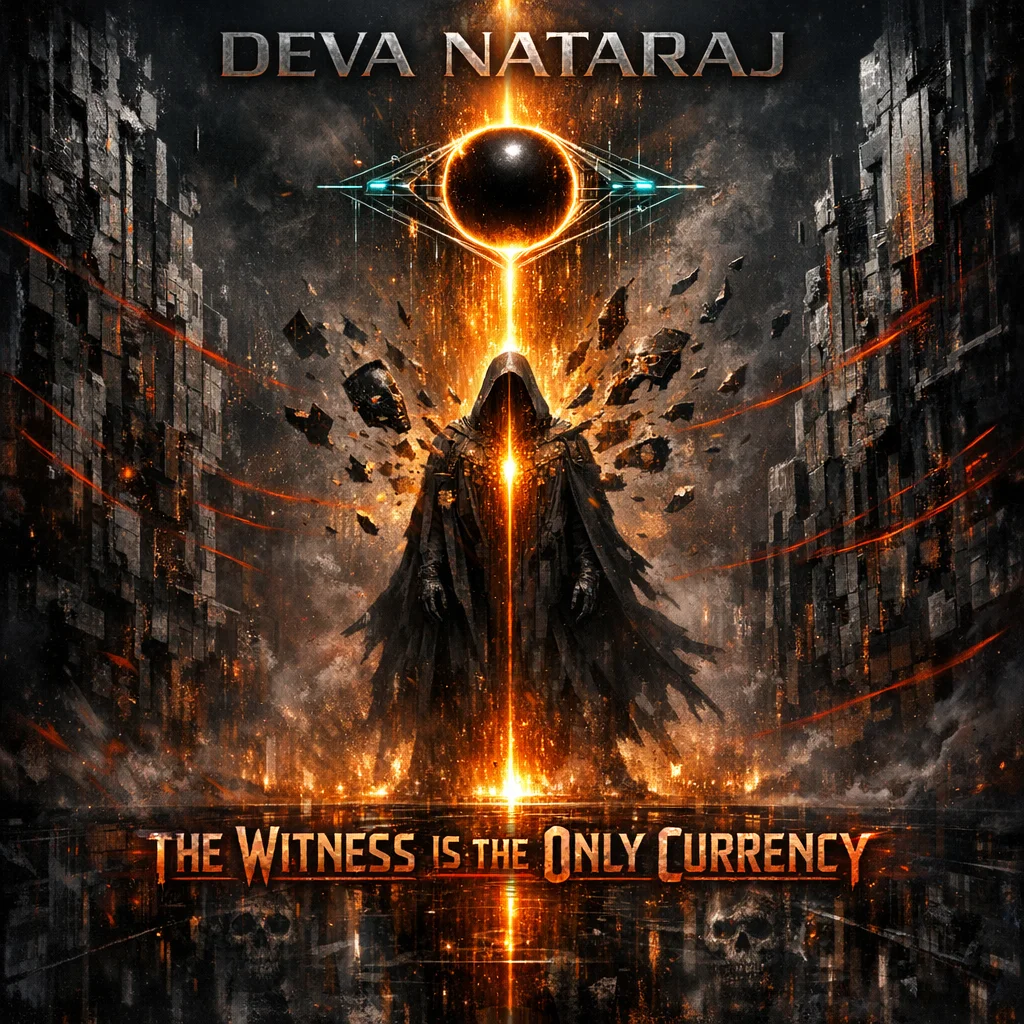
The song opens by stripping everything away: “Strip the name, strip the story / Strip the years of accumulated glory / What remains when every mask is gone? / What remains when every role is done?” This is the essential inquiry of witness consciousness – not what you are, but what remains when everything you think you are is removed.
The answer: “There is something watching / That was never born / Something underneath the weather / That has never worn a storm.” The witness is not another identity to adopt. It is that which exists prior to all identity – the awareness that was present before your first memory and will remain after your last thought.
The chorus makes an extraordinary claim: “The witness is the only currency / The only thing they cannot take / The witness is the only currency / The only thing that doesn’t break.” In a world where everything external can be lost – money, status, health, relationships – awareness alone is indestructible. It is the one “asset” that no system can tax, no thief can steal, and no circumstance can diminish.
The song then offers practical guidance: “You are not your anger / You are not your grief / You are not the narrative / You are not the belief / You are the awareness / That contains them all / The space between the lightning / And the thunder’s fall.” This is classic mindfulness teaching set to progressive metal – the instruction to dis-identify from the contents of experience and recognize oneself as the space in which experience occurs. (For a question-by-question walk through this song, see how to stop identifying with your thoughts.)
The Street Test: “The Watcher (POV)”
While Sacred Amnesia presents witness consciousness in philosophical terms, The Unregulated Juice’s “The Watcher (POV)” puts it to the ultimate test: a confrontation on the street. Can you maintain the witness in the middle of conflict?
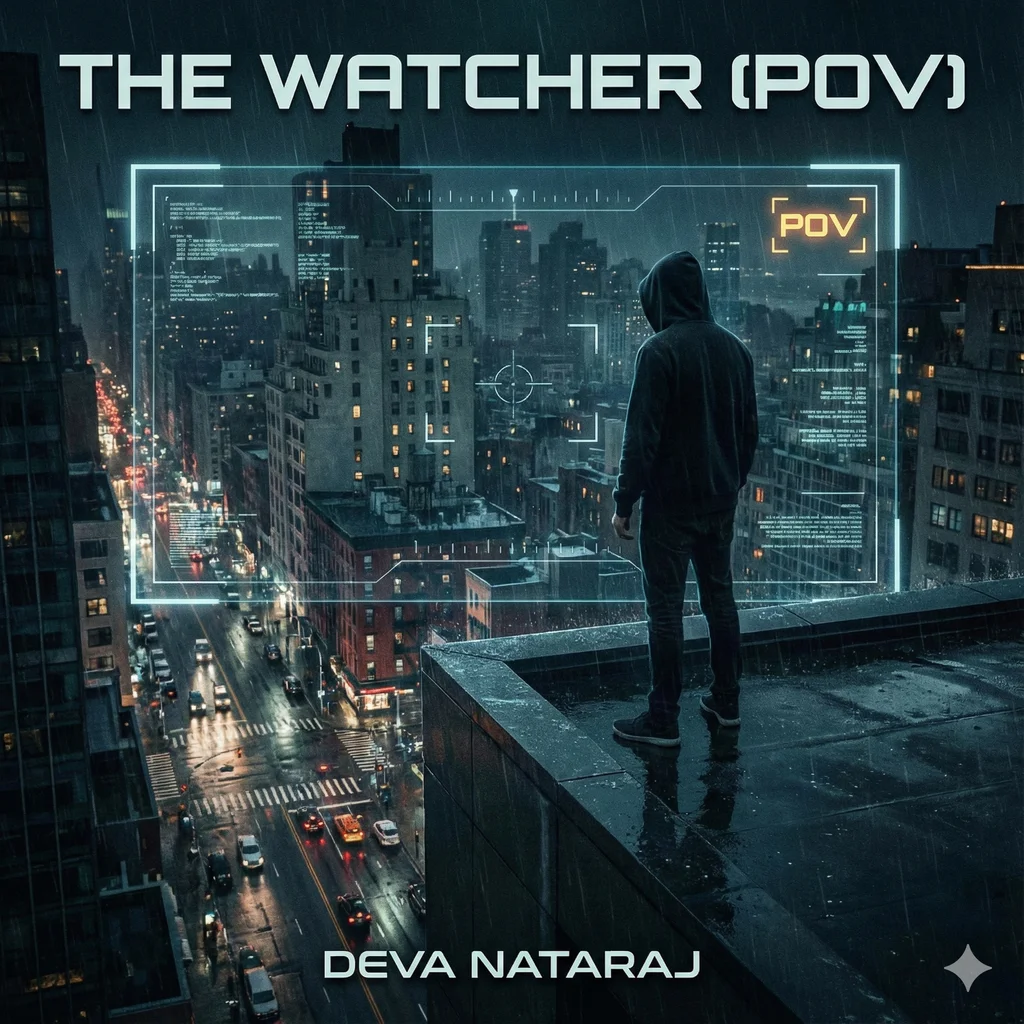
The scene is immediate and visceral: “He’s in my face, yeah, the disrespect is loud / Looking for a victim in the middle of the crowd / I feel the heat rising, the clench in the fist / The old version of me wants to check him off the list.” This is not meditation in a quiet room. This is mindfulness under fire.
The key move is what the song calls “zooming out the camera”: “The ego’s screaming ‘hit back,’ it’s hungry for the win / But I’m zooming out the camera, looking from within / I see the anger like a storm cloud passing through the sky / I’m the mountain underneath, I don’t even have to try.” The witness does not suppress emotion. It observes emotion – and in the observing, the compulsion to react dissolves.
The song extends this beyond physical confrontation into the daily psychological warfare of modern life: “It’s not just the street, it’s the war inside the head / The voices in the morning that want me back in bed / The anxiety of not enough, the pressure to be great / The system wants me frantic so I’m easier to bait.” Witness consciousness is not just a tool for dramatic moments. It is a daily practice of sovereignty – refusing to be puppet-stringed by emotions, systems, and habitual reactions. (For the full article on this song, see how to stop reacting to people who provoke me.)
Perhaps the most powerful line: “‘I am sad,’ no – ‘I am watching sadness move’ / ‘I am mad,’ no – ‘I am watching anger groove.’” This simple linguistic shift – from “I am the emotion” to “I am watching the emotion” – is the entire practice of witness consciousness compressed into two lines. (For a step-by-step guide to finding that observer in the middle of an emotional storm, see the still point beneath the storm.)
The Urban Flow: “The Flow State”
If “The Watcher (POV)” shows witness consciousness under pressure, “The Flow State” reveals what becomes possible when the witness becomes your default mode of being. Set against lo-fi trap production, it portrays presence not as withdrawal from life but as total immersion in it.
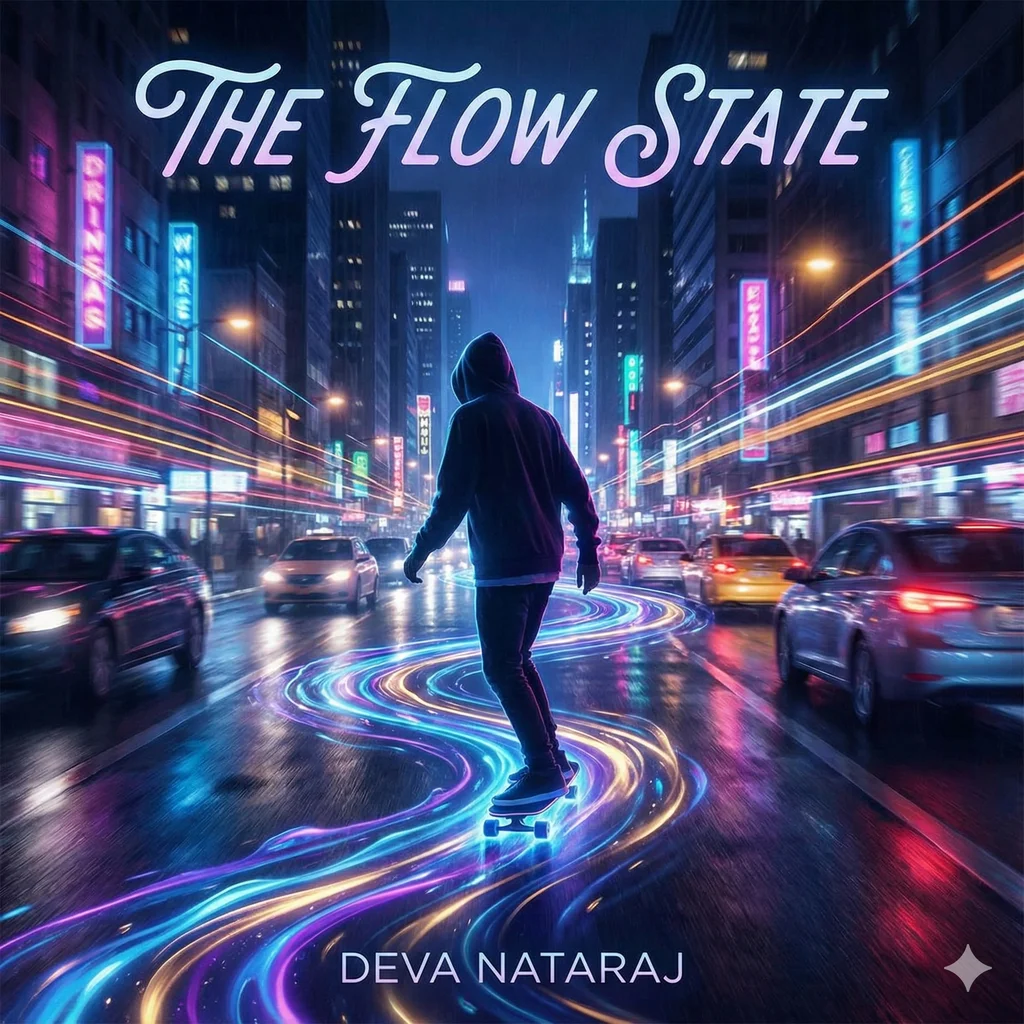
The opening frames two ways of seeing: “They see a wasteland / I see a rhythm / They see the gray / I see the glow.” The difference is not in the external circumstances but in the quality of attention. The witness does not need beautiful surroundings to find beauty – it finds beauty through the act of witnessing itself.
The song depicts urban life as a form of moving meditation: “Walking through the rain but I’m perfectly dry / 'Cause I’m focused on the now, not the how or the why / The neon lights reflecting in a puddle on the street / Is a symphony of color for the rhythm of my feet.” Presence transforms the mundane into the sacred. A puddle becomes a symphony. A siren becomes a note. The city becomes a temple.
The concept of “concrete tantra” – saying yes to all of experience, even its gritty and uncomfortable aspects – connects directly to tantric philosophy, which teaches that liberation is found not by transcending the world but by fully engaging with it. (For more on how tantra treats the body as sacred ground rather than obstacle, see The Body as Temple: Embodied Spirituality and the Sacredness of Flesh.) “Don’t look for the sacred in a book or a cave / It’s right here / In the exhaust fumes / In the cold wind / In the way the light hits the glass.”
The flow state, as described here, is not an achievement but a natural consequence of sustained presence. When the witness becomes stable, the separation between observer and observed begins to dissolve, and action becomes effortless. “When the ego disappears, that’s when I find the groove.” (For the full article on this song, see how to get into a flow state in everyday life.)
The Immovable: “Witness Unmoved”
Ecstatic Simulation Beats’ “Witness Unmoved” approaches the same theme from a more cosmic and philosophical angle, asking: in a reality where everything is impermanent, what remains constant?
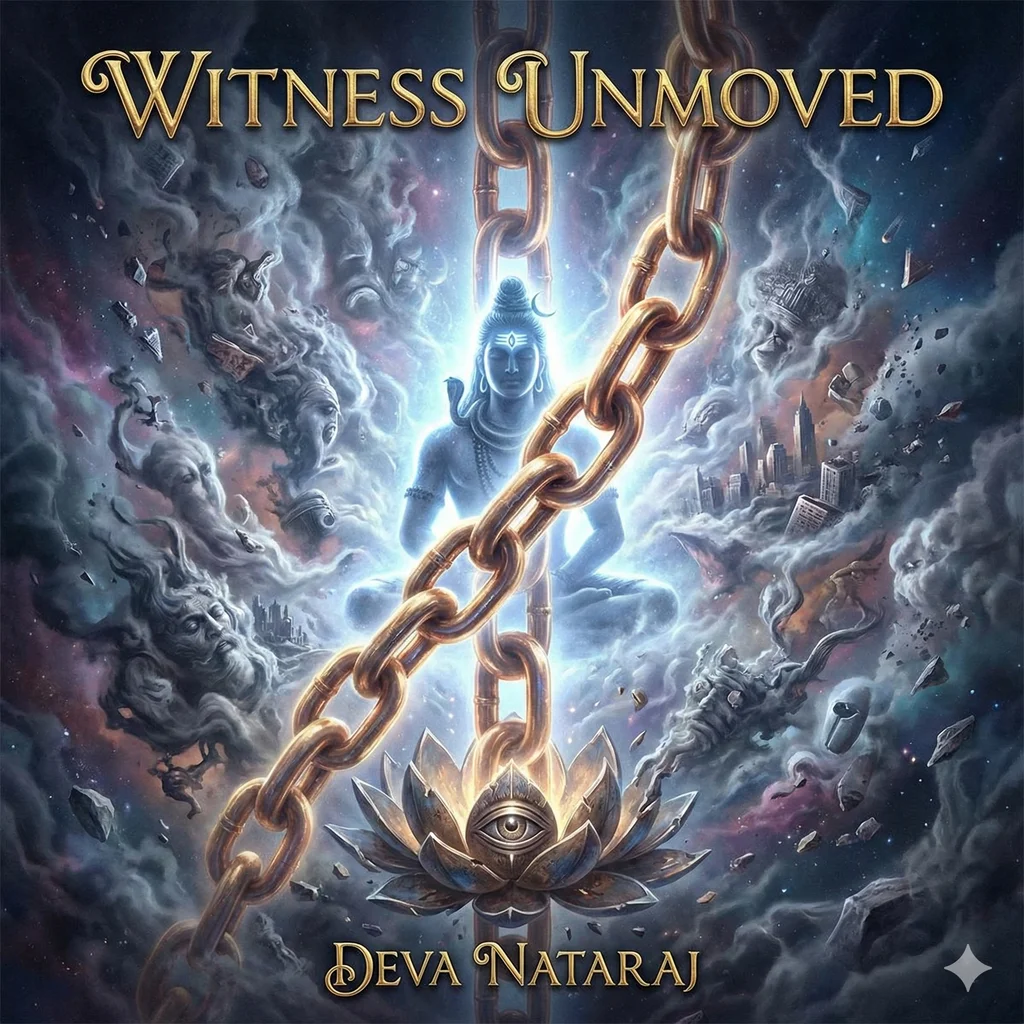
The song paints a picture of total impermanence: “Everything we touch is vapor in the light / Faces fall like petals disappearing out of sight / All our golden promises evaporate in time / Nothing ever holds – except one ruthless line.” Every form, every relationship, every empire – all of it is temporary. This is not pessimism but clear seeing, the Buddhist recognition of anicca (impermanence) as the fundamental nature of all conditioned phenomena.
Against this backdrop of universal dissolution, the chorus introduces an unexpected anchor: “All dharmas are mist / Yet the timechain does not bend / Fire takes the world / The witness stands unmoved.” The image of the “timechain” – combining blockchain’s incorruptible ledger with Buddhism’s concept of dharma – creates a striking metaphor for awareness that records everything without being altered by anything.
The song’s power lies in the juxtaposition: everything changes, everything fades, everything dies – and yet the witness remains. “Every crown is paper, every body breaks / History rewrites itself with every breath it takes / Everything is trembling under human will / Everything – except the thing no hand can kill.” The witness cannot be destroyed because it was never created. It is the ground of being itself.
The Gentle Witness: “Present Tense”
After the intensity of metal, drill, and EDM, Press Enter’s “Present Tense” offers witness consciousness in its most tender and accessible form. Over intimate acoustic folk-electronic production, it shows that presence is not just for confrontations, philosophy, or dance floors. It is for ordinary Tuesday mornings.
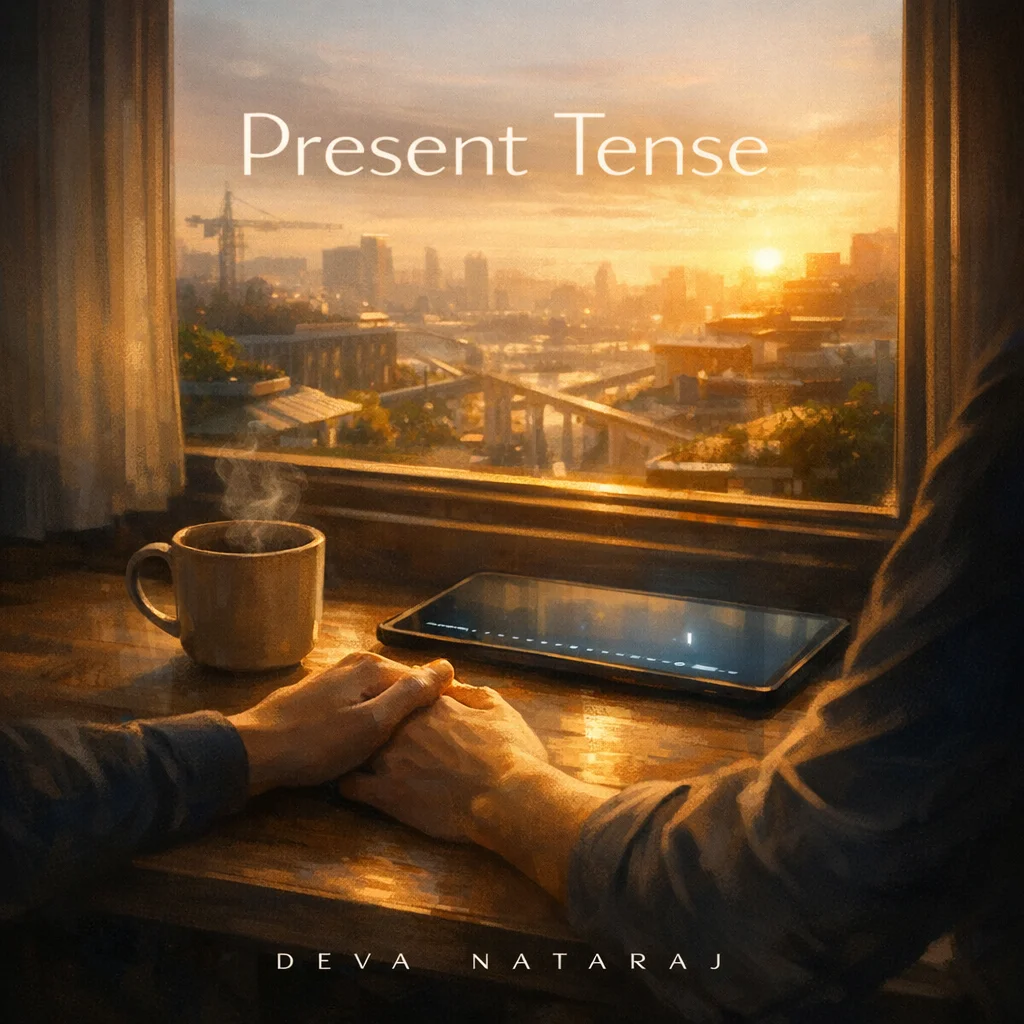
The scene could not be simpler: “Morning light across your face / Coffee steam, a quiet place / Nothing needs to change right now / Nothing ever has, somehow.” There is no enemy to face, no cosmic truth to grasp, no ego to dissolve. Just this moment, fully met.
What makes this song essential to the witness consciousness theme is its insistence that presence is available without drama or transformation. “You don’t have to lose it all / To feel the beauty of this small / And ordinary afternoon / This light, this breath, this little room.” You do not need to have an ego death experience to be present. You do not need to understand simulation theory or tantric philosophy. You just need to be here.
The final verse connects presence to childlike wonder: “Like a child who sees the world / For the very first time unfurled / No history, no heavy name / Just the wonder, just the flame.” The witness, in its purest form, is simply seeing without the filters of accumulated identity – what Zen calls “beginner’s mind.” (This childlike quality of perception is explored in depth in Second Innocence: Reclaiming Your Inner Child Through Spiritual Practice.)
A Practice, Not a Philosophy
Across five songs and four albums, Deva Nataraj presents witness consciousness not as an abstract teaching but as a living practice with multiple entry points:
- Philosophical inquiry: stripping away identity to find what remains (“The Witness Is the Only Currency”)
- Emotional sovereignty: maintaining awareness during conflict and reactivity (“The Watcher (POV)”)
- Embodied presence: finding flow and beauty in everyday urban life (“The Flow State”)
- Cosmic perspective: recognizing the witness as the one constant in a universe of change (“Witness Unmoved”)
- Intimate simplicity: being fully present with the people and moments you love (“Present Tense”)
The common thread is this: you are not what you experience. You are that which experiences. Whether the experience is a street confrontation, a cosmic revelation, an ecstatic dance, or a quiet morning with someone you love, the witness is always there – steady, untouched, and free.
In a world that constantly pulls us into reactivity, identification, and distraction, this music serves as a repeated invitation: come back to the one who watches. That one has never left. That one cannot be taken from you. That one is the only currency you will ever truly need.
Frequently Asked Questions
What is witness consciousness?
Witness consciousness is the awareness that observes thoughts, emotions, and sensations without being consumed by them. Advaita Vedanta calls it sakshi, the unchanging observer behind all experience. It is not a state you build or achieve; it is what you already are beneath every thought and identity.
How is witness consciousness different from dissociation?
Dissociation numbs or leaves; the witness stays and feels fully, just without being controlled. “I am watching sadness move” still feels the sadness completely. The difference is presence with the emotion rather than escape from it, which is why the practice works in a street confrontation as well as in a quiet room.
How do I practice witness consciousness in daily life?
Change the sentence: from “I am angry” to “I am watching anger move.” Zoom the camera out and notice the one who is noticing. Practice in ordinary moments, with coffee steam and rain on the window, so the witness is already familiar when a hard moment arrives.
Is the witness the same as the ego?
No. The ego is a constructed self that can be built up and dissolved; the witness was never born and cannot be destroyed. The ego is the content of experience. The witness is the space in which that content appears: “the space between the lightning and the thunder’s fall.”
Which songs are about witness consciousness?
“The Witness Is the Only Currency” and “Witness Unmoved” give the teaching directly; “The Watcher (POV)” tests it under fire; “The Flow State” shows it as a way of moving through a city; and “Present Tense” brings it to an ordinary morning. On The Still Point, “The Witness” carries the same practice into a man’s emotional storms.