How to See the World With Fresh Eyes (and Stop Sleepwalking Through Life)
To see the world with fresh eyes, stop letting memory and opinion answer for your senses before they arrive. Beginner’s mind is not knowing less – it is meeting each ordinary thing as if you had never met it, so a counter, a face, or a cup of water becomes vivid again instead of assumed.
Most of us do not see the world. We recognize it. A room enters the eyes and the mind files it instantly – kitchen, morning, the usual – and moves on before a single detail lands. This is efficient, and it is also how a life gets quietly spent without being felt. Deva Nataraj’s The Altar of Now keeps circling back to the antidote: not new experiences, but new seeing of the experience already in front of you.
Why does life start to feel like a blur?
Because the mind stops perceiving and starts predicting. After enough repetitions, your brain no longer looks at the coffee, the commute, or the person across the table – it retrieves a stored version and pastes it over the present. The label arrives faster than the thing, and you live inside the label.
This is what “sleepwalking” actually means. Not that you are unconscious, but that your attention has been outsourced to memory. The days run on autopilot precisely because they are familiar, and familiarity is a kind of anesthesia. In the philosophy running underneath this album, that numbness is not a personal failure – it is sacred amnesia extended into the smallest hours of the day. We forgot where we came from to enter this reality fully; the trouble is we keep forgetting the reality itself, sleeping through the very thing we crossed the universe to feel.
The way back is not more stimulation. It is less overlay – letting the world reach you before the label does.
What are “newborn eyes”?
Newborn eyes are perception without the filter of accumulated memory: seeing the ordinary as though it had no history, no name, no yet. It is the mode a baby lives in by default and an adult has to consciously recover. Nothing external changes. What changes is that attention returns to a mind that had been running on stored assumptions.
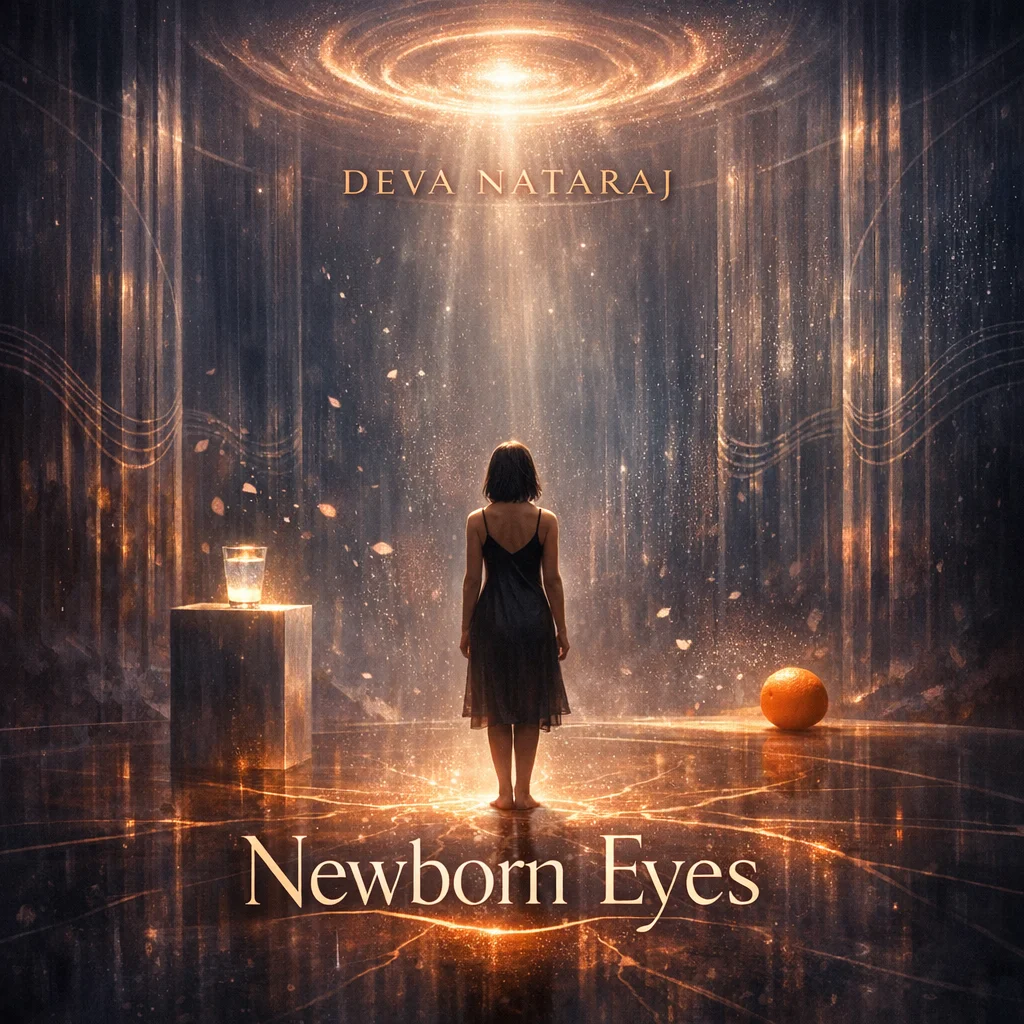
“Newborn Eyes” is the album’s clearest portrait of this shift. It opens by treating the most mundane objects as astonishments: “The orange on the counter is a planet made of light / The rain against the window is a symphony in flight.” Nothing has been added to the orange or the rain. The song simply stops the reflex of naming-and-dismissing and lets the fact of them land at full weight.
The second verse names the exact habit that fresh seeing dissolves: “I used to rush through mornings like a commuter through a gate / Now I stand inside the doorway and I let the wonder wait.” The commuter moves through a gate without seeing it because the gate is for passing through – it has been reduced to its function. To let the wonder wait is to stop treating the world as a corridor to somewhere else and start meeting it as a destination.
Then comes the chorus that gives the whole approach its precision: “I see with newborn eyes / Every surface is a surprise / The ordinary just cracked open wide / And the sacred poured outside.” And crucially: “No memory to summarize.” That single phrase is the mechanism. Ordinary seeing is memory summarizing – compressing the live moment into a headline. Fresh seeing is what remains when you drop the summary and let the raw signal through.
The song refuses to make this a private mysticism. The world does not become vivid because you left for a temple. It becomes vivid because you stopped skimming the one you are already standing in: “This is not the world I left – this is the world that’s always on.” It was always broadcasting. You were the one who had tuned out.
Isn’t this just mindfulness by another name?
It overlaps almost entirely – and that overlap is not a weakness. What the East calls beginner’s mind (Zen’s shoshin) and what the tantric traditions call witnessing are two doors into the same room: perception without grasping, awareness without the running commentary. Fresh seeing is mindfulness aimed specifically at the senses.
The bridge is the witness – the awareness behind your eyes that can watch experience without being swallowed by it. When you observe a thought instead of becoming it, the same thing happens to perception: a gap opens between the raw sight and the mind’s verdict about it, and in that gap the world gets to be new. (This observing capacity is the subject of witness consciousness and the observer within the music.)
“The Altar of Now” makes the point that this seeing needs no exotic setting to work.
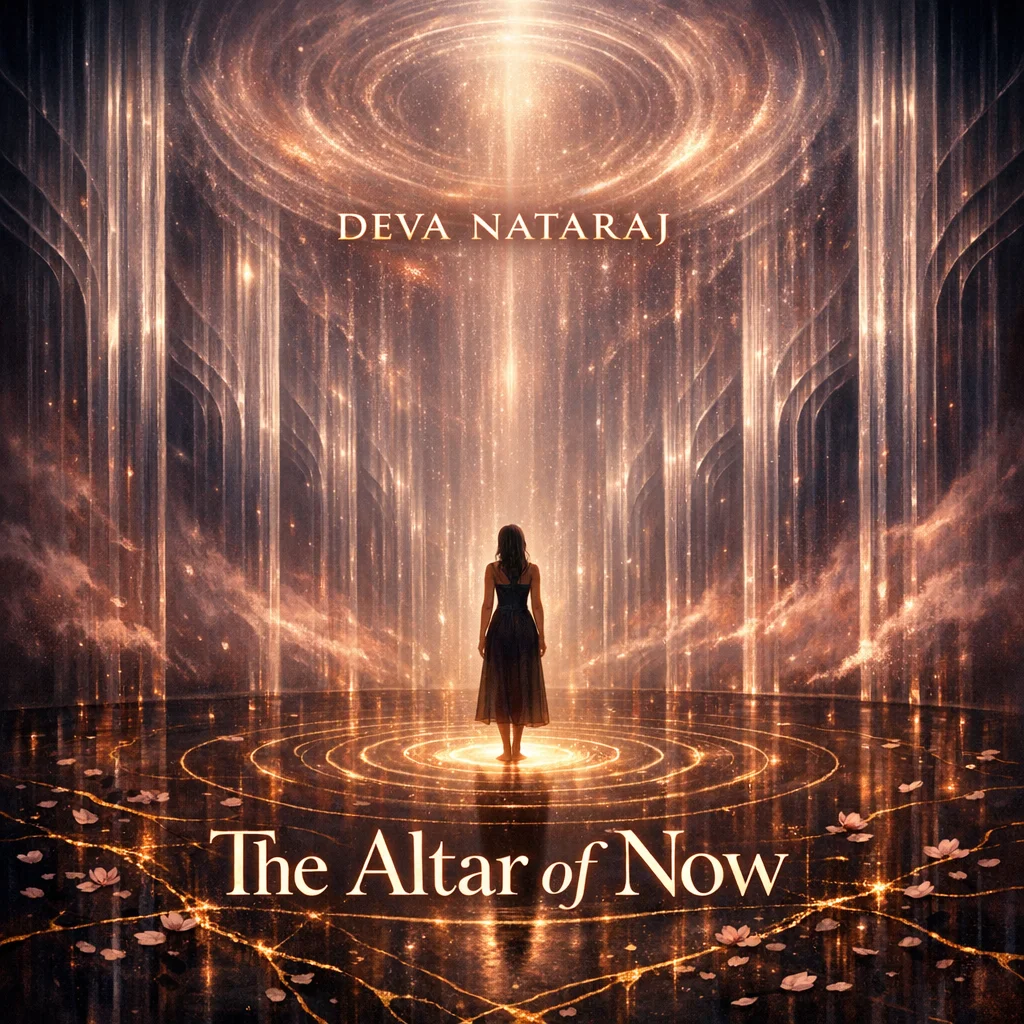
After a lifetime of seeking, the song lands the same discovery in plainer terms: “No pilgrimage, no doctrine, no ascent / Just the raw, complete amazement of the present.” And it insists the most forgettable objects qualify: “The dashboard and the dishcloth and the unremarkable sky / Are altars – if you let them be.” Fresh seeing is not a technique reserved for sunsets. It is a permission you extend to the dishcloth. The sacred was never somewhere else; it was under the summary you kept pasting over it.
How is fresh seeing different from nostalgia or naivety?
This is the distinction that keeps beginner’s mind honest, and “Newborn Eyes” states it in four words: “Not innocence – presence / Not naivety – attention.” Fresh seeing is not a retreat into a simpler, dumber, more gullible version of yourself. It is the opposite – a sharpening.
Nostalgia looks backward and colors the present with a remembered glow; it is memory doing more work, not less. Naivety is not-knowing as ignorance – a lack. What the song describes is not-knowing as choice: “The baby sees because it has no opinion yet / And I am learning, learning, learning to forget.” The baby’s clarity comes from having no accumulated verdicts standing between it and the world. The adult cannot become a baby, but can learn to set the verdicts down – to forget on purpose, so the seeing comes through clean.
That is why the song can ask, without any childishness, “What if nothing here is boring? / What if everything is new?” Boredom is not a property of the world; it is a property of stale attention. Nothing is boring to a mind that has stopped summarizing. This is presence, not regression – more awake than ordinary adult seeing, not less. (The reclaiming of play and the inner child is a related but separate move, explored in how to feel childlike wonder again; fresh seeing is its quieter cousin, concerned less with play than with plain, precise attention.)
How do you practice seeing the world new?
You interrupt the reflex that names before it looks. Pick one ordinary object – the steam off a kettle, a stranger’s hands, the light on a wall – and hold your attention on it a beat longer than the mind wants to. The mind will try to summarize and move on. Let the summary go and keep looking. “Newborn Eyes” calls this standing inside the doorway and letting the wonder wait.
Do it with people, too. The song treats a passerby as unfathomable: “The woman on the corner with the groceries in her hand / Is a sovereign universe I’ll never understand.” Fresh seeing is not only aesthetic; it is ethical. When you stop pasting a label over a person, you meet an actual being – someone on their own sacred journey through this reality, as unrepeatable as you are.
Sometimes the seeing cracks open on its own, unbidden. In “Tremor,” the album’s opening, the ordinary suddenly turns transparent: “The trees outside were louder, and the sky was paper-thin.” That involuntary vividness is the same faculty “Newborn Eyes” cultivates deliberately – proof the capacity is already in you, waiting under the autopilot. The practice is just learning to open the eyes on purpose instead of waiting for life to shake them open.
The world is already giving everything it has
Fresh eyes do not require a more interesting life. They require you to stop skimming the one you have. The orange, the rain, the dishcloth, the woman with the groceries – none of it was ever dull. It was fully present the whole time, and you were half-present to it. Beginner’s mind simply closes that gap.
“Newborn Eyes” ends on the fact this points toward: “That the world is giving everything it has, and it wants nothing back.” The generosity is total and unconditional. The only thing ever missing was a witness awake enough to receive it. To see the world with fresh eyes is not to add wonder to an ordinary life. It is to stop sleeping through a life that was extraordinary all along. (For the wider practice of inhabiting the moment this depends on, see how to live in the present moment.)
Frequently Asked Questions
What does “beginner’s mind” actually mean?
Beginner’s mind, or shoshin in Zen, is meeting each moment without the weight of accumulated assumptions – as if seeing it for the first time. It is not knowing less; it is letting perception arrive before judgment does. An expert sees what they expect; a beginner sees what is actually there. The aim is to keep the beginner’s openness alongside the adult’s depth.
How is this different from just paying attention?
It is a specific kind of attention – attention without the running commentary. Ordinary “paying attention” often means thinking harder about something. Fresh seeing means the opposite: dropping the mental labels and letting the raw sense-impression land directly. “Newborn Eyes” calls it “No memory to summarize” – perceiving the thing itself rather than your stored idea of it.
Can you really live this way, or is it just a nice idea?
You can practice it in moments, not maintain it constantly – and the moments are the point. No one holds unbroken fresh perception all day. But you can catch the autopilot, pause on one ordinary object or person, and let it become vivid again. Repeated, these interruptions slowly loosen the habit of skimming, and more of ordinary life comes back online.
Is seeing with fresh eyes the same as childlike wonder?
They are close relatives but not identical. Fresh seeing is about presence and clear perception – attention without overlay. Childlike wonder leans more toward reclaimed play, delight, and the inner child. “Newborn Eyes” is careful to separate them: “Not innocence – presence / Not naivety – attention.” This is a sharpening of adult awareness, not a return to being a child.
Which Deva Nataraj song is about seeing with fresh eyes?
“Newborn Eyes,” from The Altar of Now, is written directly about this – experiencing an orange, the rain, a stranger, and a cup of water as if for the very first time. Its companion “The Altar of Now” extends the same seeing to the dishcloth and the dashboard, insisting the ordinary is sacred the moment you actually look at it.