Why Does My Feed Make Me So Angry? Breaking the Algorithm's Grip
Your feed makes you angry because anger is the most profitable thing it can make you feel – outrage keeps the thumb moving, and a moving thumb is what the whole machine is built to sell. The content is not chosen to inform you or even to entertain you. It is chosen, minute by minute, to keep you reacting, and rage is the reaction that lasts longest.
That is the diagnosis at the heart of “Algorithmic Ghost,” the second track of Deva Nataraj’s The Unregulated Juice – a dark glitch trap song about what happens to a person who has been turned into a data point, and how they turn back.
Why does scrolling leave me furious instead of informed?
Because the feed was never optimized for what you know. It was optimized for how long you stay, and the song names the trade with cold precision:
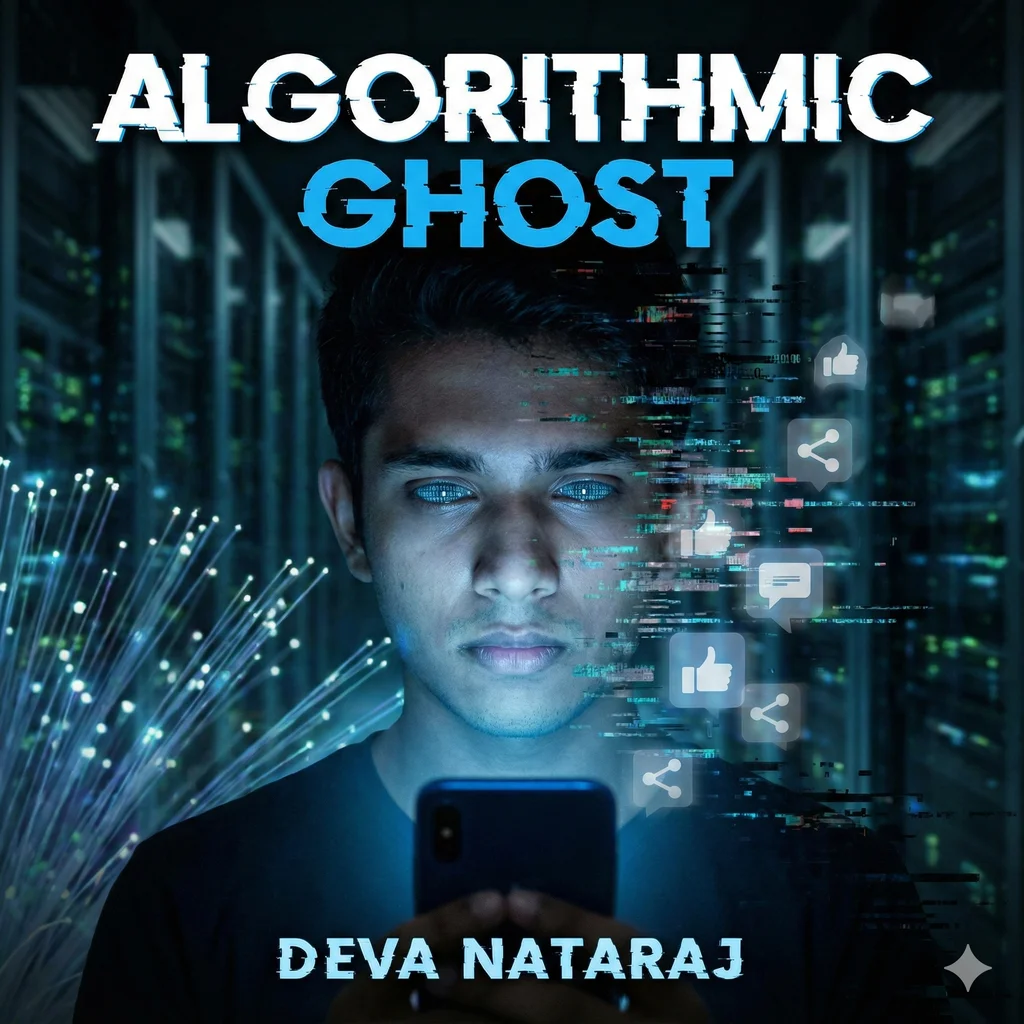
“Thumb on the glass, yeah, I’m chasing the ghost / Feeding the high with the like and the post / The algorithm knows me better than I know my face / Keeping me locked in a digital race”. Notice how little is happening in that scene. A thumb. A pane of glass. A loop. And yet it is described as a race, a chase, a high – the vocabulary of compulsion. Then the song says the quiet part aloud: “They serve me the anger, they serve me the hate / Regulation of mind while they’re filling the plate”.
Served is the right verb. You did not go looking for the post that ruined your morning. It was placed in front of you by a system that has measured, across billions of scrolls, exactly which flavor of outrage keeps you at the table. The song’s spoken opening tells you why in nine words: “They want your eyes. / They want your rage.” Rage is not a side effect of your feed. Rage is the product.
Am I really being manipulated, or is that just paranoia?
You are being engineered, and the song is careful to say it is engineering rather than conspiracy – a design, not a villain. “But it’s all engineered, yeah, it’s built to distract / To keep me from seeing the way that I act / I’m a data point screaming in a vacuum of noise / While they’re selling my focus like a room full of toys.” Your focus is the inventory. Your attention is being sold, and what it is being sold away from is the one thing that would free you: seeing the way you act.
The second verse widens the lens to the political theater the feed stages every day: “They want us at war, yeah, the left and the right / While they pick our pockets in the middle of the fight / Policy of outrage, law of the trend / Looking for a master, looking for a friend”. This is why the anger feels so righteous and so useless at once. It is real anger, but it has been aimed for you – pointed at a stranger on the other side of a screen while the actual mechanism runs untouched in the middle. (For the pattern by which fury feeds on itself until it has nowhere left to go, see breaking the cycle of anger.)
Then the line that cuts closest: “But the screen is a mirror of the emptiness inside / A place for the coward and the victim to hide”. That is not an insult; it is a diagnosis offered to oneself. The feed works because there is a hollow in us it fits. Outrage is a very convincing imitation of being alive. It has heat, urgency, a sense of mattering. And it asks nothing of us that a thumb cannot provide.
How do I break the algorithm’s grip on my attention?
Not by winning the argument in the comments – by stepping back far enough to see the thumb move. The song’s bridge is a meditation instruction dressed as a drill breakdown: “Look at the thumb. / Watch it move. / Who is moving it? / You? Or the machine? / Step back. / Inside the head, there is a space. / The Witness is quiet. / The screen is just glass. / The outrage is just a spark in the wire. / I am the silence. / LOG OUT.”
Read it slowly, because every line is a step. First, look at the thumb – bring the automatic movement into awareness. Second, ask who is moving it, honestly, without shame. Third, step back into the space that was there before the scroll started: “inside the head, there is a space.” That space is what the whole Deva Nataraj catalog calls the witness – the awareness that notices anger without being made of it. From that space the phone is revealed for what it physically is, glass, and the outrage for what it physically is, a spark in a wire. Neither is the thing you were treating it as.
The hook makes the same move in a single phrase: “Delete the ghost. / Become the host.” An algorithmic ghost is someone haunting a screen, present nowhere, reacting to everything. A host is someone at home in their own attention, deciding who gets in. The shift between them is not a matter of willpower or a better app. It is a shift of identity – from I am the reaction to I am the one who can watch the reaction and put the glass down. (For the wider practice of reclaiming the hours the scroll has been taking, see how to stop doomscrolling and wasting your life.)
What do I get back when I log out?
The minute. The hour. Presence – which the song calls the only real power in a world of ghosts. “I see the trap now, I see the design / They can have the data, but they can’t have the mine / I’m reclaiming the minute, I’m reclaiming the hour / In a world full of ghosts, the presence is power.” Seeing the design does not make it disappear. It makes it yours to refuse. The data was always theirs; the mine – the interior, the attention itself – was never for sale until you handed it over one thumb-flick at a time.
This is where the sovereignty running through The Unregulated Juice becomes something you can feel rather than argue. The philosophy underneath this music holds that we each entered this reality for a reason we cannot fully recall, and that the only place we can feel toward that reason is the present moment. A feed is a machine for keeping you out of that moment. Every hour spent as a ghost is an hour of your actual, sacred, unrepeatable life spent looking at glass. There is nothing puritanical in noticing that. It is simply an accounting, the same one “Paper Burn” opened the album with: what are you spending, and what are you getting?
The song’s last lines answer the fear that logging out means missing something: “The feed never ends. / But you can. / Right here. / Right now. / Sovereign in the silence.” The feed will not end. That is its nature; it is built to be infinite. But you are not infinite, and you were not built to scroll. You can end. You can put the glass face down and hear the room you are in. What the song promises is not a quieter life but a seen one – a world met with fresh eyes instead of through a curated pane of provocation. (For that first-sight quality of attention once the filter comes off, see how to see the world with fresh eyes.)
The screen is just glass
The line to keep is the one that shrinks the monster to its true size: “The screen is just glass. / The outrage is just a spark in the wire.” Your feed makes you angry because anger is what it was built to farm, and the harvest only works while you mistake the spark for a fire and the glass for a world.
You do not have to win. You do not have to correct anyone. You only have to look at the thumb, ask who is moving it, and step back into the space that was always behind the screen. Delete the ghost. Become the host. The feed never ends – but you can, right here, right now, sovereign in the silence.
Frequently Asked Questions
Why does social media make me angry all the time?
Because outrage is the emotion that keeps you scrolling longest, and the feed is ranked for time-on-screen rather than for truth or wellbeing. “Algorithmic Ghost” states it directly: “They serve me the anger, they serve me the hate.” The anger is not an accident of what you happen to see; it is the product being served.
Is the algorithm deliberately manipulating me?
It is engineered rather than personally malicious – a design tuned across billions of scrolls to find whatever keeps each person reacting. The song calls you “a data point screaming in a vacuum of noise” whose focus is being sold “like a room full of toys.” Seeing the design is the first step out of it.
How do I stop reacting to provocative posts?
Watch the thumb before it moves and ask who is moving it. The song’s bridge is the practice in miniature: step back, notice “inside the head, there is a space,” and recognize that “the screen is just glass” and “the outrage is just a spark in the wire.” From that space the compulsion loosens on its own.
What does “delete the ghost, become the host” mean?
A ghost haunts a screen, present nowhere, reacting to everything. A host is at home in their own attention and decides what gets in. The shift is not a better app or more willpower but a change of identity – from being the reaction to being the one who watches it and can put the phone down.
Which Deva Nataraj song is about social media addiction and outrage?
“Algorithmic Ghost,” from The Unregulated Juice, is written directly about it – a dark glitch trap track that names the feed as a rage machine and ends with an instruction: “The feed never ends. / But you can.”