How Do I Stop Doomscrolling and Wasting My Life? Waste the Simulation
You stop doomscrolling and wasting your life by remembering two things the scroll is designed to make you forget: that you chose to be here, and that the hours are not free. Every numb evening dissolved into a screen is spent from a finite allocation you fought to receive, and nothing on the feed is worth the price. The way out is not more willpower against the phone. It is recovering the sense that this life is yours, chosen on purpose, and that there is something you came here to do with it.
That is the argument Deva Nataraj’s Sacred Amnesia makes at full thrash-metal velocity in its third track, “Waste the Simulation” – a furious song about games within the game, the numbing hit, and the question of how you will score when the run is read back.
Why does doomscrolling feel so bad and yet so hard to stop?
Because it is a substitute for a purpose you can feel bleeding out but cannot name. “Waste the Simulation” opens on a scene almost everyone will recognise:
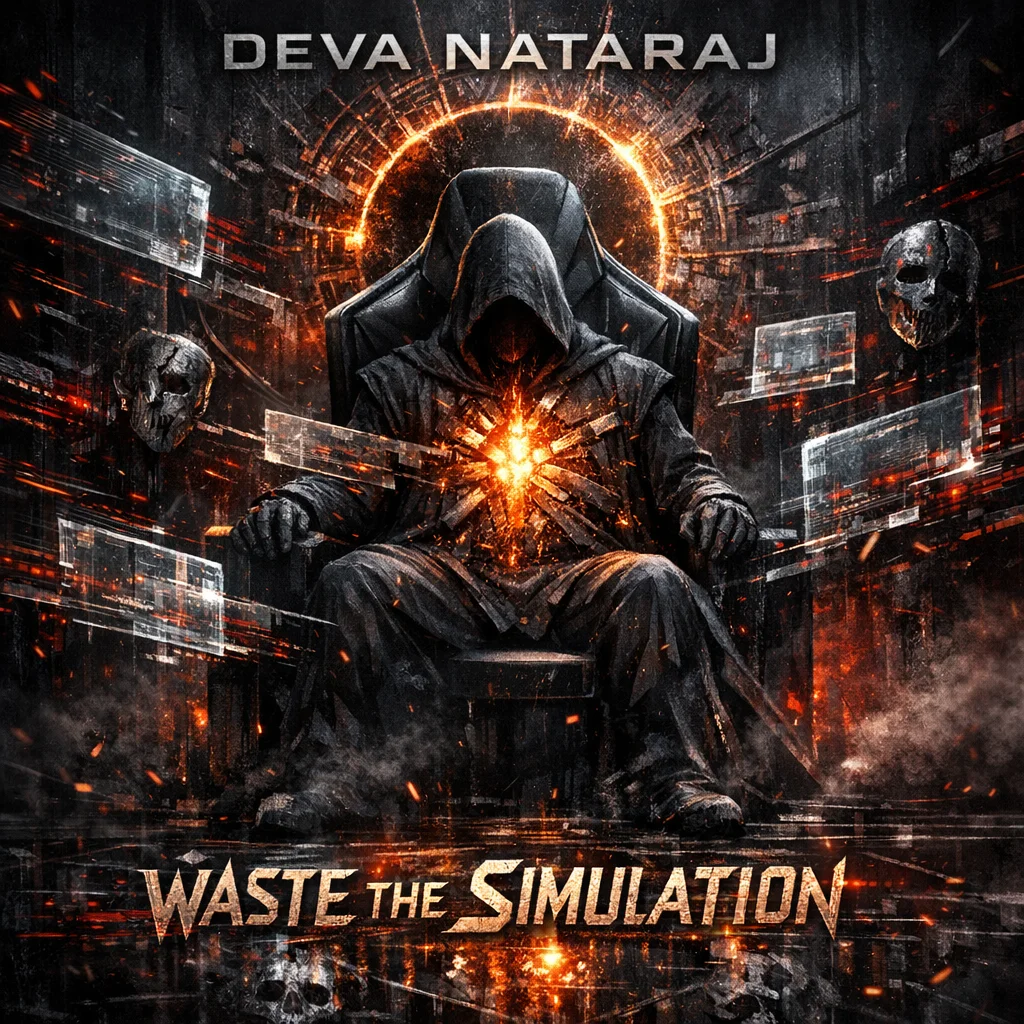
“Another night dissolves inside the screen / Scrolling through the wreckage of your dreams / You had a purpose - can you feel it bleeding? / Or did the algorithm drown the screaming?”. The genius of the feed is that it is almost nourishing. It offers the shapes of connection, of learning, of outrage that feels like caring, of other people’s lives that feel like living. It is food-shaped, which is why you keep reaching for it, and it is empty, which is why you are never full. The scroll does not feel bad because you are weak. It feels bad because something in you knows the difference between watching and being, and is screaming about it under the noise.
The song’s second verse states the problem with the plainness of a slap: “You chose to come here / You fought to get in / Now you’re lying on the couch / Watching someone else’s skin”. In the philosophy behind the album, arriving in this reality was not an accident. It was a choice, and a costly one: consciousness fought its way through the gate and deliberately forgot its origin in order to live one finite, embodied life to the full. Set against that, the couch is not a rest. It is a refusal of the thing you came for. The discomfort you feel mid-scroll is not guilt imposed from outside. It is the purpose, still alive, objecting.
What is the scroll actually costing me?
More than the hours, and the song is precise about the accounting. “This cost you something back in Arkhe / Time and resources you can’t get back / Now you’re burning through the allocation / Scrolling, swiping, fading into black”. Arkhe, in the album’s cosmology, is the home reality we come from and return to between lives. The idea here is that this life was not free: it was paid for, in some currency you cannot now remember, and it comes with a finite allocation of time and vitality. Every hour on the feed draws that allocation down and buys nothing with it. You are not merely wasting an evening. You are spending an inheritance you crossed a universe to collect.
The song’s chorus turns this into a question it never lets you dodge: “How will you score? / How will you score? / When the simulation ends / And they’re reading back the war / Every wasted hour, every numbing hit / How will you score when they’re counting it?”. Score here is not moral judgement from a cosmic referee. It is the question you will ask yourself when the memory returns and you see the whole run laid out: the days you were fully present and the days you fed to the feed. The album’s philosophy holds that death is a homecoming in which all memories return. Imagine reviewing this life with everything remembered. The scroll will not show up as rest. It will show up as absence. (For the practice of actually being here in the hours you have, see how to live in the present moment.)
Isn’t entertainment allowed? Why call it “games within a game”?
Entertainment is allowed. Numbness is the problem, and the song is careful about the difference. “Games within a game within a game / You built a castle in a castle made of frames / Entertainment hollowed to the bone / Playing other people’s lives and not your own”. A story that moves you, a game that absorbs you, music that cracks you open – these are not waste. They are part of the game you came to play, ways of experiencing more fully. The waste is entertainment hollowed to the bone: content stripped of everything except the ability to hold your thumb in place. The tell is simple. Nourishing play leaves you more alive afterwards. The scroll leaves you emptier than it found you, and you know it, which is why you reach for the next hit.
The philosophy behind the album is tantric in its refusal to condemn pleasure. There is no virtue in a joyless life, no prize for renunciation, and no requirement to throw your phone in a river. The marketplace is as holy as the monastery; the question is only whether you are present in it. That is exactly the question the song’s bridge asks, and it asks it gently, in a lull between the assaults: “Could you find that meaning here / In a more magnificent way? / Could you take this flesh and breath / And make it burn today?”. Not could you deprive yourself. Could you find more magnificence. The scroll is not too much pleasure. It is far too little, dressed up as plenty. (For why the feed specifically farms your anger and how to step out of that loop, see why does my feed make me so angry.)
How do I actually break the habit?
By refusing the story that you are its victim. The song’s last verse is the practical heart of the whole track: “You are not a victim and you are not a slave / You are a consciousness that chose this wave / So ride it or lie down - the choice was always yours / But don’t pretend the game has locked the doors”. This is not a denial that the algorithm is engineered against you. It is. But the engineered pull only works on someone who has forgotten they have a choice, and the entire point of the song is to remind you that you do. The doors are not locked. They were never locked. You can stand up.
Concretely, the shift the song asks for happens before any app is deleted. It is a shift in identity: from someone this is happening to to someone who chose this wave and can ride it. From there, the practical moves are obvious and much easier to keep. Put the phone in another room when you sleep, because the allocation is finite. Replace the first scroll of the morning with something that uses your flesh and breath: a walk, a stretch, a piece of music heard all the way through. Notice, in the moment of reaching for the screen, what silence you are trying to drown, and let yourself hear it for ten seconds before you decide. The tantric principle at work is that awareness transforms what force cannot: you do not have to fight the habit, only to see it clearly, every time, until seeing it becomes more interesting than obeying it.
And take the hard nights seriously, because they are real. The scroll usually thickens when something hurts. The album’s philosophy does not ask you to pretend the pain is not there; it asks you to meet it rather than mute it, because a pain met with awareness becomes something you can grow through, while a pain numbed with a feed just waits. (For the case that difficulty is part of what you came here for, not an error to be scrolled past, see does suffering have a purpose.)
The choice was always yours
The line to keep from “Waste the Simulation” is the one that hands the run back to you: “So ride it or lie down - the choice was always yours / But don’t pretend the game has locked the doors”. You stop doomscrolling not by winning a war against your phone but by remembering what your phone was built to make you forget: that you fought to get in here, that the hours are drawn from a finite allocation, and that watching someone else’s skin is not the same as living in your own.
The song ends on its question three times over, “How will you score? / How will you score? / How will you score?”, and it leaves it open, because the answer is still being written. Take this flesh and breath. Make it burn today.
Frequently Asked Questions
Why is doomscrolling so hard to stop?
Because it is purpose-shaped without being purpose: it offers the outline of connection, learning, and caring while delivering none of them, so you never feel finished. “Waste the Simulation” names the mechanism as an algorithm drowning the scream of a purpose you can still feel bleeding. The pull is engineered, but it only works on someone who has forgotten they have a choice.
What does doomscrolling actually cost me?
The song’s accounting goes beyond hours: “This cost you something back in Arkhe / Time and resources you can’t get back”. In the album’s cosmology, this life was chosen and paid for, and it comes with a finite allocation of time and vitality. Every numb hour spends that allocation and buys nothing. The cost is presence itself, the one thing you came here for.
Is all entertainment a waste of life?
No. Stories, games, and music that leave you more alive afterwards are part of the game you came to play. The waste is “entertainment hollowed to the bone”, content stripped of everything except the ability to hold your attention. The test is simple: nourishing play fills you; the scroll leaves you emptier than it found you.
How do I actually break the doomscrolling habit?
Start with identity, not apps. “You are not a victim and you are not a slave / You are a consciousness that chose this wave”. From that stance, the practical moves hold: keep the phone out of the bedroom, replace the first scroll of the day with something that uses your body, and notice what silence you are drowning before you reach for the screen. Awareness dissolves what willpower can only fight.
Which Deva Nataraj song is about doomscrolling and wasting your life?
“Waste the Simulation,” the third track of Sacred Amnesia, is a thrash-metal assault on exactly this: nights dissolving into the screen, games within the game, the finite allocation spent on numbing hits, and the question that never stops, “How will you score?”