How Do I Get Into a Flow State in Everyday Life? Concrete Tantra
You get into a flow state in everyday life by giving yourself totally to whatever is actually in front of you – the walk, the dish, the conversation, the rain – until the one doing it and the doing are no longer two things. Flow is not a special condition that requires a mountain or a studio. It is what happens when the ego stops narrating and the moment is allowed to be enough.
That is what “The Flow State,” the sixth track on Deva Nataraj’s The Unregulated Juice, sets to a melodic lo-fi trap beat: a walk through a wet city that turns, block by block, into a moving meditation the song names “concrete tantra.”
Why can’t I find flow in my ordinary life?
Because you have been told it lives somewhere else – in a cave, a book, a retreat, a better job – and the song’s first move is to refuse that geography. It opens with two ways of seeing the same street:
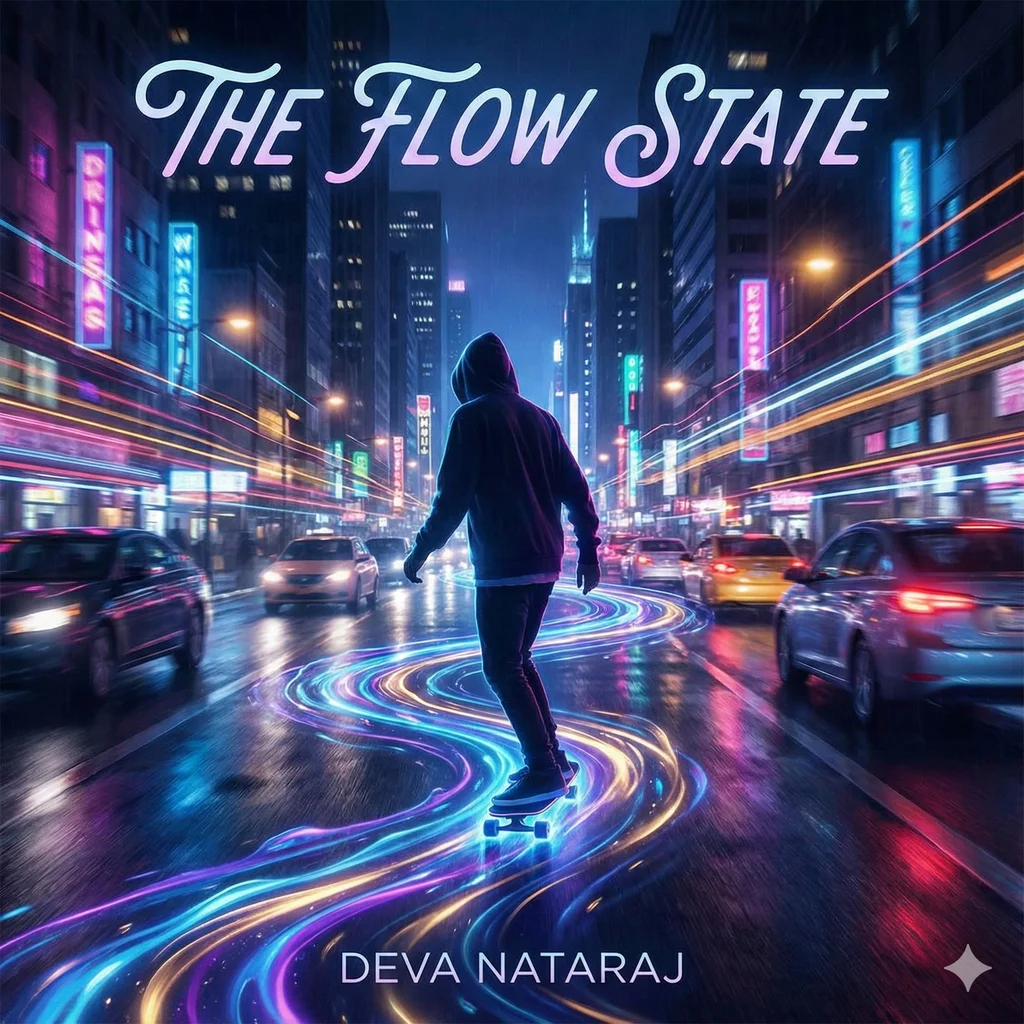
“They see a wasteland. / I see a rhythm. / They see the gray. / I see the glow. / It’s all energy. / Just watch how I move.” Nothing about the city has changed between those lines. What changes is the quality of attention brought to it. And the song is specific about what that attention does to a rainy walk: “Walking through the rain but I’m perfectly dry / 'Cause I’m focused on the now, not the how or the why / The neon lights reflecting in a puddle on the street / Is a symphony of color for the rhythm of my feet”.
Not the how or the why is the key. Flow is blocked by two habits of mind: strategizing (how do I get through this?) and justifying (why is this happening to me?). Both pull you out of the puddle and into a story about the puddle. The song’s answer is to stay with the color. “Every siren is a note, every engine is a beat / I’m finding the heaven right here on the concrete.” Heaven is not being brought to the concrete. It is being found there, because it was there already. (For the broader practice of returning to this moment rather than a future one, see how to live in the present moment.)
What does “concrete tantra” mean?
It means saying yes to the whole of experience – the gray and the glow, the pain and the pleasure – rather than waiting for the pleasant half to arrive before you agree to be present. The hook says it directly: “It’s the flow state, moving like a river through the stone / In a city of millions, I’m sovereign and alone / But I’m connected to the pulse, yeah, I’m tapping the vein / Finding the pleasure in the middle of the pain / Concrete tantra, yeah, I’m saying yes to it all”.
Tantra, in the sense this project draws from, is the tradition that says there is nowhere to escape to: this body, this street, this moment is the sacred ground, and the marketplace is as holy as the monastery. “Concrete tantra” is that idea with the poetry stripped off and the exhaust fumes left in. The song’s spoken passage makes the location explicit: “Don’t look for the sacred in a book or a cave. / It’s right here. / In the exhaust fumes. / In the cold wind. / In the way the light hits the glass. / Be total. / Whatever you do, do it with everything.” Be total is the entire instruction. Not calm, not serene, not spiritual – total. Flow is what totality feels like from the inside.
And the yes is not selective. “I’m not dodging the chaos, I’m joining the song / In the middle of the mess is where I belong / They call it a struggle, I call it a dance / Nothing in this city is a matter of chance”. The struggle and the dance are the same set of movements; the difference is whether you are resisting them or moving with them. A river does not fight the stone. It flows through, and the stone becomes the shape of its flowing. (For how a first-sight quality of attention turns a familiar street back into an unfamiliar one, see how to see the world with fresh eyes.)
How do I actually enter flow, step by step?
By protecting the energy, dropping the timeline, and giving yourself completely to the next small act. The second verse is the closest the song comes to a method, and it starts with what not to do: “Don’t leak the juice, yeah, don’t waste the fire / On a temporary fix or a hollow desire / The energy is rising from the ground to the crown / I’m the only thing light in this heavy-duty town”. The juice of the album title is life-force, and flow requires a full tank. Every hollow desire – the scroll, the snack, the argument – is a slow leak, and a leaking person cannot pour themselves into anything.
Then the drop into the act itself: “Total immersion in the act of the move / When the ego disappears, that’s when I find the groove / I’m the skater on the rail, I’m the writer on the wall / I’m the presence in the moment, standing ten feet tall”. Look at the examples. A skater on a rail. A writer on a wall. Neither is thinking about themselves while they do it; the moment the skater thinks I am skating well, the rail is lost. The ego is the narrator, and flow begins exactly where the narration stops. And the last piece of the method is the emptying of the pockets: “No past in my pocket, no future in my head / Just the electricity of being not-dead.” That phrase, being not-dead, is the whole thing. Flow is the raw electricity of being alive with nothing added.
Isn’t flow just for athletes and artists?
No – and the song’s whole point is that it is the natural state of anyone who is fully here, doing anything. The skater and the writer are examples, not prerequisites. The philosophy beneath this music holds that meditation is not sitting with closed eyes but awareness carried into every ordinary act: walking, eating, working, loving, all become meditation when done with total attention. Flow is simply the felt texture of that. The song calls itself “the witness in the lobby,” “the ghost on the train,” “the silence in the middle of the heavy metal rain” – three utterly ordinary places, each turned into a temple by the person standing in it.
There is a sovereignty in this that connects to the rest of the album. The song says it is “sovereign and alone” in a city of millions and, in the same breath, “connected to the pulse.” Those are not contradictions. Sovereignty here means your attention is your own – not administered by a feed, a price, or a provocation – and once it is your own, you can give it fully to what is in front of you. That giving is the connection. You cannot pour from a tank someone else is draining. (For the witness practice that keeps attention sovereign in the first place, see witness consciousness and mindfulness.)
The hook’s last lines carry the only warning the song offers: “Keep your eyes open. / Keep your heart fast. / Everything is moving, nothing’s gonna last.” Impermanence is not a reason for sadness here. It is the reason to be total now, because now is the only place the dance is happening.
The dance never stops, you just have to join in
The line to keep is the song’s last: “The dance never stops. / You just have to join in. / Presence… / On the concrete.” How do you get into a flow state in everyday life? You stop waiting for a better venue. The rain is the venue. The siren is a note. The mess is where you belong, and the struggle and the dance are the same movement seen from two sides.
Don’t leak the juice. Drop the past from your pocket and the future from your head. Give the next small act everything you have, and notice the moment the narrator goes quiet. That silence is the groove. The city has been playing it the whole time; the only thing missing was you.
Frequently Asked Questions
What is a flow state, in plain terms?
It is total immersion in what you are doing, to the point where the one doing it and the doing stop being two things. “The Flow State” describes it as “Total immersion in the act of the move / When the ego disappears, that’s when I find the groove”. The narrator in your head goes quiet, and what is left is the act itself.
Can I find flow in a boring, ordinary day?
Yes – the song’s whole argument is that flow is not a special condition but the natural state of anyone fully present, anywhere. Its examples are a lobby, a train, a rainy street. “Don’t look for the sacred in a book or a cave. / It’s right here. / In the exhaust fumes.”
What does “concrete tantra” mean?
It means saying yes to the whole of experience, the gray and the glow together, rather than waiting for the pleasant half before agreeing to be present. Tantra treats this body and this street as the sacred ground; concrete tantra is that teaching with the exhaust fumes left in.
What blocks flow the most?
Two habits: strategizing about how to get through the moment, and justifying why it is happening – “not the how or the why.” Both pull you into a story about the experience instead of the experience. Leaking your energy into hollow distractions is the other block the song names.
Which Deva Nataraj song is about flow state and presence in the city?
“The Flow State,” the sixth track of The Unregulated Juice, is written directly about it – a lo-fi trap walk through a wet city where every siren is a note and the closing instruction is “The dance never stops. / You just have to join in.”