Why Do I Feel Like I'm Wearing a Mask Around People?
You feel like you are wearing a mask around people because you are – and you made it yourself, layer by layer, out of what you were praised for and what you were afraid of. The mask is not a lie you are telling. It is a piece of armor that was forged in childhood to keep you safe, and it worked so well that you have forgotten there was ever a face underneath it. The strangeness you feel in company is the metal reminding you it is there.
Deva Nataraj’s Sacred Amnesia devotes its second track to exactly this construction. “Iron Masks” is a heavy groove metal song about identity as a forging process: the hammer, the anvil, the heat of fear and praise, and the moment the metal cools with you still inside it.
Where does the mask come from?
From the forge of other people’s expectations, worked hot over years. “Iron Masks” opens on the anvil and does not look away from it:
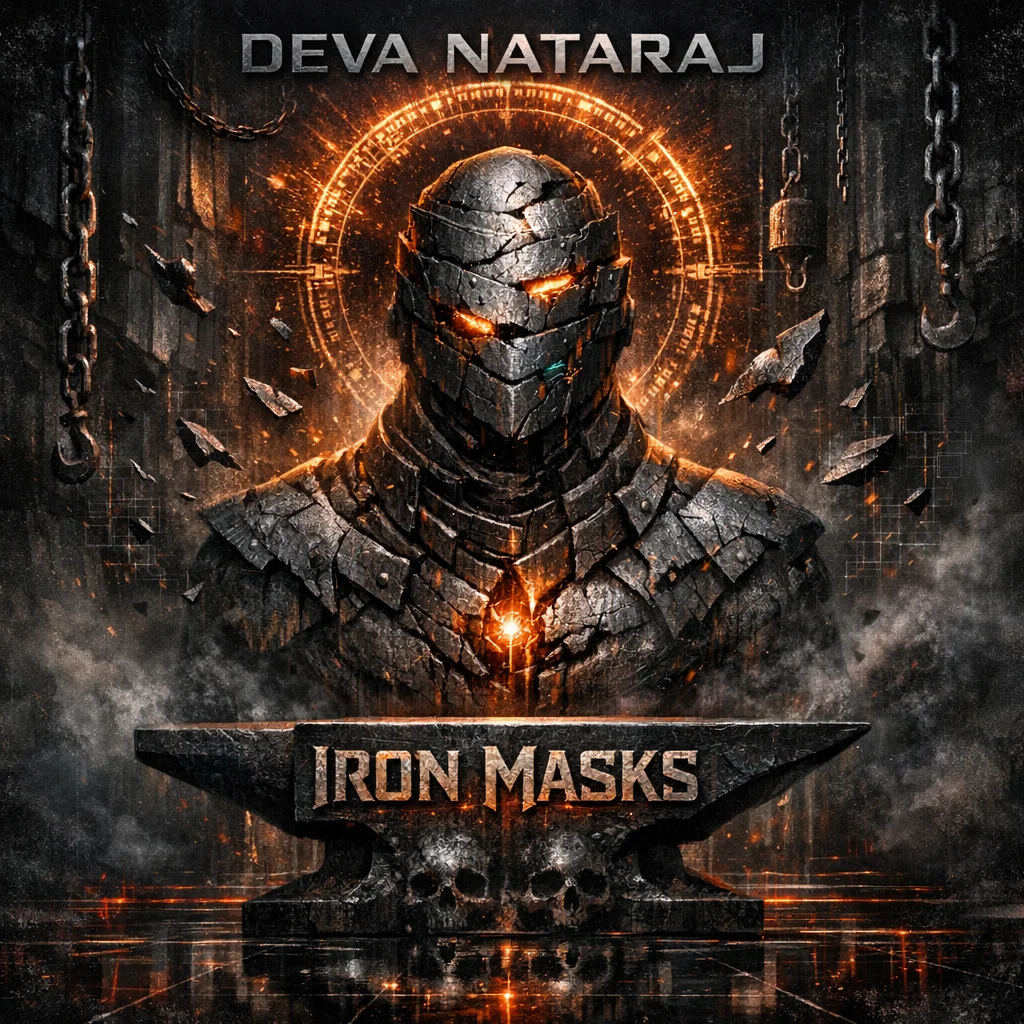
“Hammer falls on the anvil of the self / Another layer, another name to wear / Father, worker, believer, ghost / Every label is another mask to bear”. Each blow is a role. None of them is evil. Father, worker, believer are ordinary, even honourable things to be. The problem is not the roles; it is that each one adds a layer, and the layers were never taken off. Then the song names the raw materials: “I built this face from what they told me / Forged it hot from fear and praise / Now the metal’s cooled and I’m inside it / Staring out through iron days”. Fear and praise are the two hammers. You learned which version of yourself got approval and which got punished, and you hammered yourself into the approved shape before you were old enough to know you were doing it. The philosophy behind the album calls this accumulated conditioning the ego: not a villain, just borrowed beliefs and secondhand shapes that harden around a self that was never consulted.
The line that most people recognise is the verse about instructions: “They said be strong, they said don’t break / They said the world will eat you if you shake / So I became the wall, became the gate / Became the armor and forgot my face”. That is the mechanism in four lines. Somebody who loved you, or somebody who frightened you, told you that softness was dangerous. You believed them, because you were small. And the belief did not stay a belief; it became a body. (For how those borrowed instructions get taken apart, see spiritual unlearning: who are you without your story.)
Why does the mask make me feel numb instead of safe?
Because iron does not feel. The song’s chorus is a lament about sensation, not about deception: “Iron masks - I cannot feel the rain / Iron masks - I cannot feel the flame / Forged in fear, cooled in shame / I don’t even know my name”. Notice that the complaint is not people can’t see the real me. It is I can’t feel anything. Armor is indiscriminate. It keeps out the blow, and it also keeps out the rain, the flame, the hand on the shoulder, the sun on the neck. This is why a well-built mask produces the peculiar loneliness of being surrounded by people and touched by none of them. You are not being rejected. You are simply unreachable, and the wall you built to survive is doing exactly what walls do.
The philosophy underneath the album insists that the body is the temple, that sensation is the doorway, that being present in the flesh is the whole point of having come here. The mask is a refusal of that. It was a reasonable refusal at the time; a child who is being eaten by the world has every right to build a wall. But a wall that stays up after the danger has passed stops protecting a life and starts replacing it. “Every expectation is another bolt / Every judgment is another weld / I thought I was protecting something fragile / Now I can’t remember what I held”. That last couplet is the quiet tragedy at the centre of the song. The armor was built around something precious. The building took so long that the something was forgotten. All that is left is the shape of the protecting.
Is there really a “real me” under the mask?
Yes, and it is far less dramatic than you fear. People avoid looking under the mask because they suspect the face beneath is monstrous, or empty, or full of everything they were told to hide. The song looks, and finds something else: “Underneath the iron, underneath the rust / There’s something softer than the things I trust / Underneath the armor, underneath the weight / The face I’m hiding isn’t full of hate”. Not hate. Not rage. Not a void. Something softer than the things I trust, which is a precise description of why it got covered: softness was the one thing the forge was built to eliminate.
Then the song lets the metal drop away and says the simplest possible thing about what remains: “It’s just a face / Bare and unafraid / And it’s been waiting since the day I made / This cage”. It’s just a face. That is the anticlimax that heals. You are not hiding a secret self that would horrify the room. You are hiding an ordinary, undefended face that has been waiting, patiently, without resentment, since the day the first layer went on. The album’s philosophy would call this the witness, the awareness that was never forged and therefore never cooled, the thing that watched every hammer fall without becoming iron itself. Nothing you did to yourself reached it. It is still bare. It is still unafraid. It only needs the cage opened. (For the moment of realising the person you are looking for was never actually lost, see why do I feel like I lost myself.)
How do I take the mask off without falling apart?
By changing what you want, not by attacking what you are. The song’s final chorus is identical to the first except for one verb, and that one verb is the whole practice: “Iron masks - I want to feel the rain / Iron masks - I want to feel the flame / Drop the forge, break the frame / Speak the forgotten name”. Cannot becomes want to. Nothing else has to happen first. You do not have to smash the mask, expose yourself to everyone at once, or confess your whole history at a dinner party. You have to want the rain more than you want the safety, and that wanting, held honestly, begins to open the metal on its own. The tantric principle the album draws on says that force creates resistance and awareness dissolves it: when you bring the light of attention to the armor, it starts to soften without being fought.
In practice, this looks like small acts of unguardedness with people who have earned them. Saying I don’t know instead of performing certainty. Letting a feeling cross your face before the manager inside you tidies it. Telling one person one true thing you would normally weld shut. Each of these is a bolt removed, and each time the world fails to eat you, the forge loses a little of its authority. You will feel exposed, because you are exposed. That is what feeling the rain means. The exposure is not the failure of the process; it is the process working. (For the practical side of lowering your defenses without losing your footing, see how to let your guard down.)
Drop the forge is the deeper instruction. It is not enough to remove old layers if the hammer is still swinging; every new room you walk into will start a new mask. Dropping the forge means noticing the moment fear or praise reaches for the anvil, and declining to add the layer. Speak the forgotten name is the last line for a reason. The name is not a secret word. It is whatever it sounds like when the bare face speaks for itself, without the roles talking over it. The album as a whole treats this uncovering as a kind of death of the built self, and the fire only burns what was never really you. (For the full arc of that dissolution across the catalogue, see ego death in music.)
The face you are hiding is not full of hate
The line to keep from “Iron Masks” is the one that ends the fear: “The face I’m hiding isn’t full of hate”. You feel like you are wearing a mask because you built one, out of fear and praise, from the instruction that the world would eat you if you shook. It cooled with you inside it. And underneath the iron, underneath the rust, there is nothing to be ashamed of – just a face, bare and unafraid, that has been waiting since the day the cage was made.
You do not have to become someone new to take it off. You have to want to feel the rain, drop the forge, and let the bare face speak. It has been ready the whole time.
Frequently Asked Questions
Why do I feel like I’m wearing a mask around people?
Because you built one, usually in childhood, from what earned you praise and what you were afraid of. “Iron Masks” describes it as a forge: “I built this face from what they told me / Forged it hot from fear and praise”. The mask was protective, but it cooled with you inside it, and the strange distance you feel in company is that armor still in place.
Why does wearing a mask make me feel numb rather than safe?
Because armor is indiscriminate: it keeps out the blow and also the rain, the flame, and the hand on the shoulder. The song’s chorus is a lament about sensation, “Iron masks - I cannot feel the rain / Iron masks - I cannot feel the flame”, not about deception. A mask makes you unreachable rather than protected, which is why you can be surrounded by people and touched by none of them.
Is there a real self underneath the mask, or is it masks all the way down?
There is a face underneath, and it is gentler than you fear. The song looks under the iron and finds “something softer than the things I trust” and then simply “It’s just a face / Bare and unafraid”. The awareness that watched every layer go on was never forged, so it never cooled. It is waiting, not hiding anything monstrous.
How do I take the mask off without falling apart?
Change what you want before you change what you do. The final chorus swaps “Iron masks - I cannot feel the rain” for “Iron masks - I want to feel the rain”, and that wanting is the practice. Then remove bolts one at a time with people who have earned it: admit you don’t know, let a feeling show, say one true thing. Each time the world fails to eat you, the forge loses authority.
Which Deva Nataraj song is about wearing a mask and the false self?
“Iron Masks,” the second track of Sacred Amnesia, is written directly about it: identity as armor forged from fear and praise, the numbness of living inside cooled metal, and the bare, unafraid face that has been waiting underneath since the cage was made.