Why Can't I Remember Anything From Before I Was Born? Sacred Amnesia Explained
You cannot remember anything from before you were born because the forgetting was not an accident – it was the price of admission. In the philosophy that runs beneath Deva Nataraj’s music, consciousness enters this reality the way a player enters a game so absorbing that it must forget it is a game, because remembering would make the whole experience weightless. That deliberate, complete forgetting is called sacred amnesia, and it is not a flaw in you. It is the design.
Deva Nataraj’s album Sacred Amnesia takes its name from exactly this idea, and its opening track, “Enter the Simulation,” is a crushing progressive metal depiction of the moment it happens: the first word, the boundary conditions, the choice to walk through the gate, and the first breath in a body that does not remember what it is.
What does “sacred amnesia” actually mean?
Sacred amnesia is the idea that we chose to forget where we came from so that this life could be genuinely lived rather than merely observed. “Enter the Simulation” narrates the choice from the inside, before the forgetting closes over:
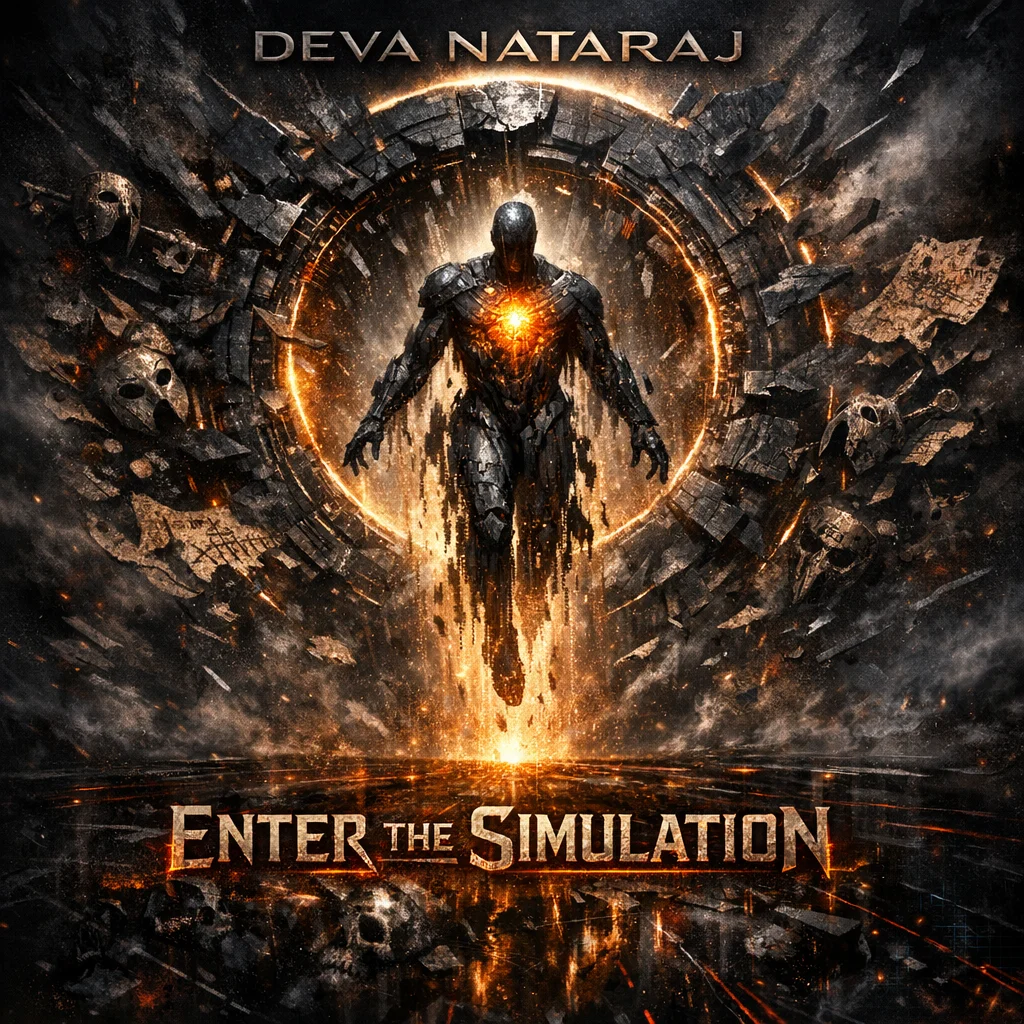
“We wrote the laws of light and gravity / We coded distance, depth, and time / Then stood before the gate and chose to enter / Knowing we would leave our minds behind”. Notice the order. First the making, then the standing at the gate, then the choosing – with full knowledge of the cost. Nobody was pushed. The song’s picture of the origin is a creation from a prompt: “In the beginning there was nothing / A void without a name / Then a word - another - a chain of fire / And the boundary conditions came”. A word, then another, then a chain reaction of becoming, held inside a frame of rules. Light, gravity, distance, depth, time. Those are the boundary conditions, and we are the ones who set them.
Then comes the line that gives the concept its name: “We blocked ourselves from memory / We burned the map, we broke the key / Divine amnesia - sacred and complete / To play the game we had to fall asleep”. Burning the map and breaking the key are not things done to a prisoner. They are things a person does when they want to make absolutely sure they cannot cheat. The amnesia is sacred because it protects the purpose. If you knew why you came, you could not do what you came to do. (For the wider picture of how simulation theory runs through the whole catalogue, see simulation theory in music.)
Why would anyone choose to forget?
Because a life you can see through is not a life. The song puts the trade in one devastating pair of lines: “Enter the simulation / Forget the ones who sent you here / Enter the simulation / Trade eternity for the weight of a tear”. That is the exchange in full. Eternity, the timeless knowing, all the memories of every previous life and of home – exchanged for something as small and as heavy as a single tear. It sounds like a terrible bargain until you notice that eternity cannot cry. Only something finite, something that can lose and be lost, can feel the weight of a tear. The forgetting is what makes feeling possible.
Think about what it would mean to keep the memories. If you remembered that death was a homecoming, no goodbye would cost anything. If you remembered that every stranger was an old friend, no kindness would be a risk. If you remembered that you wrote the rules, nothing could surprise you. Every experience that makes a life worth having – love, courage, grief, discovery, wonder – depends on not knowing how it ends. The philosophy behind the album holds that each of us came here for a reason that is genuinely our own: to learn something, to heal something, to build something, to have an adventure that was not possible where we came from. And it holds that knowing the reason would make it impossible to fulfil. So the not-knowing is not a wound. It is the condition under which the purpose can be met at all.
The song captures the compression of scale that follows: “A billion years compressed to one first breath / The body opens and the knowing dies / What was infinite becomes a heartbeat / What was luminous becomes a pair of eyes”. Everything vast becomes something small enough to be here. That is not diminishment. A heartbeat can be felt. A pair of eyes can meet another pair of eyes. Infinity cannot do either.
Is this the same as reincarnation or past lives?
It rhymes with them, but the emphasis is different. Traditions that speak of reincarnation often frame the forgetting between lives as a veil to be lifted, a loss to be recovered, sometimes a punishment. Sacred amnesia frames it as an authored forgetting, closer to an artist choosing constraints than to a soul being wiped clean against its will. “Galaxies erupted from our dreaming / Matter formed where nothing was / We shaped the stage, then walked into the drama / Forgot we were the ones who wrote the cause”. We are not extras who wandered onto a set. We built the stage. The drama is ours. And the last thing we did before stepping into it was to forget that fact, because a play in which the actors keep breaking character to check the script is not a play anyone would want to be inside.
The philosophy names the place we forgot as Arkhe – the reality that created this one, where we exist when we are not here, and where we return when this life ends. Arkhe is not a reward or a heaven you have to earn. It is simply home, the place the map led to before we burned it. What sacred amnesia protects is the distance between here and there. The distance is the whole point. It is also why the feeling of almost-remembering is so common: a stranger’s face that seems known, a piece of music that feels older than you, a moment of déjà vu that never resolves. The song’s narrator says it plainly: “I am here now / Skin and bone and blood / I do not remember what I was / But something in my chest still knows the flood”. The memory is gone. The knowing that there was something is not. (For the ache of almost-remembering and how the album treats it, see are we living in a simulation.)
If I chose to forget, does that change how I should live?
Yes, and in a direction that is almost the opposite of what people expect. If the forgetting was chosen, then the confusion you feel about your purpose is not evidence that you have no purpose. It is evidence that the design is working. You are exactly as lost as you agreed to be, and the response is not to strain after the memory but to live so completely that the purpose gets fulfilled without ever being named. The philosophy behind the album says that only in this moment can we feel what is meaningful to us. Presence, not recollection, is the compass.
This is why the song ends not on a note of loss but on a birth: “The silence after entry / The first cry / The sacred amnesia has begun / And I am finally alive enough to die”. Read that last line slowly. To be alive enough to die is to be finite at last, exposed, mortal, capable of stakes. It is the moment the game becomes real. In Arkhe, nothing could be risked. Here, everything can. That is not a tragedy; it is what we came for. The album’s philosophy carries a related instruction – to be like a newborn, seeing everything for the first time, knowing nothing of “yet” – and sacred amnesia is simply the cosmic version of that newborn’s first sight. You are meant to meet this world without a map. (For how that first-sight quality can be reclaimed in adult life, see second innocence and reclaiming the inner child.)
None of this asks you to believe anything you cannot verify. The proposition is practical: if you treat your forgetting as sacred rather than as a defect, you stop mourning a memory you cannot have and start inhabiting the one life you can. You stop asking existence to hand you the reason and start feeling toward it, one present moment at a time. Whether or not the metaphysics is literally true, a person who lives as if their forgetting was chosen tends to live with more courage and less resentment than one who lives as if they were dumped here and abandoned.
The forgetting is what makes you real
The line to keep from “Enter the Simulation” is the one that names the trade honestly: “Trade eternity for the weight of a tear”. You cannot remember before you were born because you burned the map yourself, on purpose, so that this life could weigh something. What was infinite agreed to become a heartbeat. What was luminous agreed to become a pair of eyes – yours.
So the absence you sometimes feel, the sense that there was a before you cannot reach, is not a hole in your memory. It is the shape of the door you walked through. Something in your chest still knows the flood. You do not need to remember what you were to be, right now, finally alive enough to die – and therefore finally alive.
Frequently Asked Questions
Why can’t I remember anything from before I was born?
In the philosophy behind Deva Nataraj’s music, the forgetting is deliberate: consciousness chooses to enter this reality and blocks its own memory of where it came from, because knowing would make the purpose of the life unattainable. The forgetting is called sacred amnesia. It is not a defect in your mind; it is the condition that makes a real, finite, feeling life possible.
What is sacred amnesia?
Sacred amnesia is the chosen, complete forgetting of our origin when we enter this reality. “Enter the Simulation” describes it as burning the map and breaking the key so that we cannot cheat: “Divine amnesia - sacred and complete / To play the game we had to fall asleep”. It is sacred because it protects the purpose we came here to fulfil.
Is sacred amnesia the same as reincarnation?
It overlaps with reincarnation but frames the forgetting differently. Instead of a veil imposed on the soul, it is an authored constraint, chosen by the one who forgets, like an artist choosing limits. The place we forget is called Arkhe, home between lives, and the distance from it is what gives this life its weight.
If I chose to forget, how am I supposed to find my purpose?
Not by remembering, but by being present. The philosophy holds that only in this moment can we feel what is meaningful to us, so purpose is approached as a compass rather than a map. Confusion about your reason for being here is not evidence that you lack one; it is evidence that the forgetting is working as designed.
Which Deva Nataraj song is about sacred amnesia and forgetting before birth?
“Enter the Simulation,” the opening track of Sacred Amnesia, is written directly about it. It narrates the creation from a prompt, the choice to enter, the deliberate forgetting, and the first breath in a body that does not remember what it was, ending on the line “The sacred amnesia has begun / And I am finally alive enough to die”.