What Is a Kundalini Awakening? The Body as Gateway, Not Prison
A kundalini awakening is the moment the energy that has been sleeping at the base of your spine begins to rise, moving up through the body and lighting each centre it passes until the whole of you is awake at once. In the tantric understanding, that energy is not foreign, dangerous, or dirty. It is the life force you were born with, coiled and waiting, and the body it rises through is not a prison to escape but the temple where the awakening happens.
Deva Nataraj’s Sacred Amnesia gives this its slowest and most ritual track. “Temple of Bone” is a doom-heavy hymn to the body as sacred instrument: breath slowing, marrow humming, the serpent waking, and the flame rising through root, gut, heart, throat, and eye.
Where does kundalini energy come from, and what is it?
It comes from the base of the body, and it is simply the energy of being alive, concentrated and asleep. “Temple of Bone” begins by slowing everything down until you can hear it:
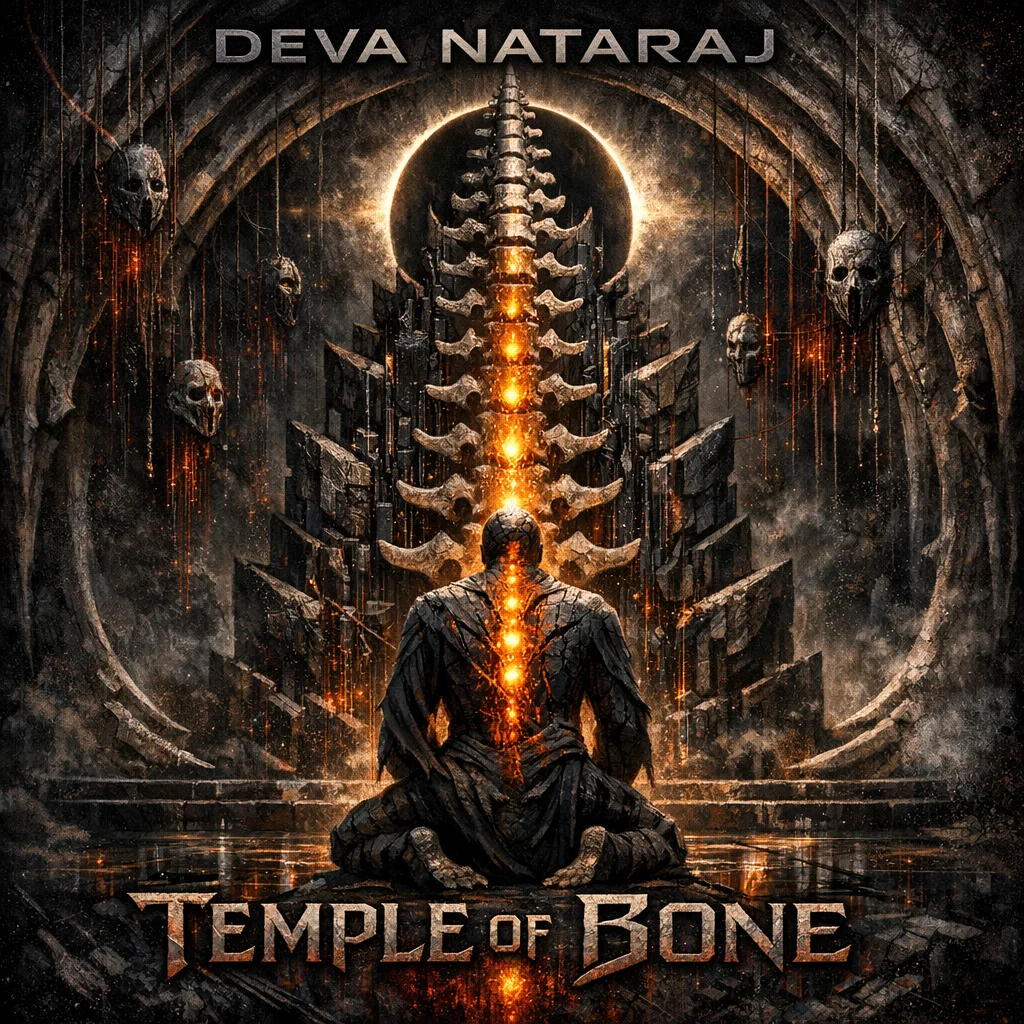
“Slow the breath / Feel the marrow hum / Something older than the mind / Is waking in the drum”. That is the first teaching, before any doctrine: the energy is older than the mind. It is not a concept you learn and then feel. It was there before you had words, in the marrow, in the pulse, and the mind is a late arrival that mostly gets in the way. The song then describes the classical anatomy with striking economy: “The spine is the pillar / The breath is the door / Energy coiled at the base of the floor / Not evil, not dirty, not something to fight / The serpent is sleeping - she’s waiting for light”. In the tantric tradition the album draws on, this coiled energy is the kundalini, imagined as a serpent lying dormant at the root of the spine. She is feminine, she is patient, and she is not your enemy. She is waiting for light, which is to say for awareness. The breath is the door because breath is the one bodily process that lives on the border between the automatic and the chosen, and slowing it is how you knock. (For the wider sense in which this force is feminine and creative, see what is shakti feminine energy.)
The philosophy behind the album treats all energy – sexual, creative, emotional, vital – as one energy, expressed at different frequencies. Kundalini is that one energy in its most concentrated form. It has nothing to do with being spiritual in the sense of being above the body. It is the body, waking up to itself.
Why do so many traditions treat the body as an obstacle?
Because a body that feels is a body that cannot be controlled, and control has always been easier to sell than aliveness. The song names the inheritance directly: “They told you flesh was sinful / They told you blood was shame / They built a wall between your body and the flame / But tantra tears the wall down / Tantra walks right through / The temple isn’t somewhere else - / The temple is in you”. Almost every listener carries some version of that wall. It was built by religion, by family, by a culture that sold shame as morality, and it stands between you and the flame, between the body you have and the energy that lives in it. Ascetic spirituality reinforces the wall by promising that the sacred is somewhere else: above, beyond, after death, in the mind. Tantra makes the opposite claim. The temple is not somewhere else. There is nowhere else. The flesh you were taught to be ashamed of is the only place the sacred has ever been available to you.
This is why the song’s chorus reads like architecture: “Temple of bone, cathedral of blood / Altar of nerve and sinew and flood / Sacred architecture, meat and divine / Every cell a prayer, every vein a shrine”. Meat and divine, side by side, with no hierarchy between them. The tantric principle at work is non-duality: there is no sacred versus profane, no higher versus lower. The marketplace is as holy as the monastery; the body is as holy as any cathedral, and considerably more useful, since you live in it. A kundalini awakening is what happens when that is felt rather than believed. (For the shame that most people have to shed before the wall can come down, see how to heal body shame.)
What actually happens during a kundalini awakening?
The energy rises, and what it passes through opens. The song’s central verse is the process itself, one centre at a time: “Rise through the root, rise through the gut / Rise through the heart where the old wounds shut / Rise through the throat where the truth was chained / Rise through the eye where the fire remained”. Read as a map, this is the classical ascent through the chakras: root, belly, heart, throat, brow. Read as an experience, it is more honest than most descriptions, because the song names what is stored at each station. The heart is where the old wounds shut. The throat is where the truth was chained. The rising energy does not glide upward through empty tubes; it meets everything you have closed, every grief you sealed off and every sentence you swallowed, and it opens them on its way through. This is why an awakening can be overwhelming, and why the tantric approach is not to force it but to slow the breath and let it come. Force creates resistance. Awareness dissolves it.
The song insists that the eye at the top is where the fire remained. The fire was never gone. It was always in you, waiting at the crown for the rest of the body to catch up. And when the rising reaches it, the song’s claim is that you do not leave the body behind. The opposite. “Even in a simulation / The body that you wear is real / The pain is real, the pleasure is real / The fire is something you can feel”. This is the point where the album’s two philosophies meet. The Johannes cosmology holds that this reality may be a simulation, chosen and entered on purpose; tantra holds that the body is the temple. The song refuses to let one cancel the other. Even if everything around you is a construct, the sensation in your spine is not. Internal reality is always genuine, and kundalini is internal reality at its most undeniable.
Do I have to give up the world to awaken?
No, and the song is emphatic that the reverse is true: you have to enter the world more fully. “You didn’t come here to transcend the flesh / You came here to inhabit it / To burn inside this mortal frame / And find the holy in the grit”. This is the album’s most direct rejection of escape-spirituality. In the philosophy behind the record, we deliberately chose embodiment, chose to be finite, chose a body that can hurt and be touched and grow old, because there was something we could only learn or experience or build from inside one. To spend that body trying to get out of it is to waste the thing we crossed a universe to have. The awakening is not an exit. It is the moment of finally, completely arriving.
That means the practice is ordinary and available. Slow the breath. Feel the marrow hum. Put your attention at the base of the spine and let it stay there without demanding anything. Notice what closes in the heart when a memory rises, and breathe into the closing instead of around it. Let the throat say one thing it has been keeping chained. None of this requires a retreat or a guru, and the tantric warning against grasping applies: you are not trying to make the serpent rise, you are removing the reasons she stays asleep. She is waiting for light, and light is only attention held steadily on the body you already have. (For the full embodied case that the flesh is where the spirit lives, see body as temple embodied spirituality.)
The song ends on a repetition that becomes a ground: “Temple of bone / Temple of bone / The only ground you’ll ever own / Temple of bone / Temple of bone / You were never meant to walk alone”. The only ground you’ll ever own. Everything else can be taken. The body is the one place that is unambiguously yours to inhabit. And the last line quietly widens the temple: you were never meant to walk alone. The awakened body is not a private achievement. It is what lets you meet other bodies, other temples, with the wall down.
The temple is in you
The line to keep from “Temple of Bone” is the one that ends the search: “The temple isn’t somewhere else - / The temple is in you”. A kundalini awakening is not an escape from the flesh into something purer. It is the flesh waking up: the sleeping serpent at the base of the spine rising through root, gut, heart, throat, and eye, opening every old wound and chained truth on the way, until the fire that always waited at the crown is felt in every cell.
You did not come here to transcend the body. You came here to inhabit it, to burn inside this mortal frame, and to find the holy in the grit. Slow the breath. Feel the marrow hum. She is waiting for light.
Frequently Asked Questions
What is a kundalini awakening?
It is the rising of dormant life energy from the base of the spine up through the body’s centres into full awareness. Tantra pictures this energy as a sleeping serpent at the root, “not evil, not dirty, not something to fight”, waiting for the light of attention. When she rises, what she passes through opens: old wounds in the heart, chained truths in the throat, the fire at the crown.
Is kundalini energy dangerous?
It is powerful, and it can be overwhelming when it meets everything you have closed off, which is why the tantric approach is to slow the breath and let it come rather than force it. “Temple of Bone” frames the energy as older than the mind and native to the body, not an intruder. Force creates resistance; steady awareness lets it move at the pace you can hold.
Why does tantra say the body is a temple rather than an obstacle?
Because there is nowhere else for the sacred to be. The song rejects the inherited teaching that “flesh was sinful” and “blood was shame” and answers: “The temple isn’t somewhere else - / The temple is in you”. In the album’s philosophy, we chose embodiment on purpose; the body is the instrument we came here to play, not a cage to escape.
Do I need to renounce the world to have a kundalini awakening?
No. “You didn’t come here to transcend the flesh / You came here to inhabit it”. The practice is ordinary: slow the breath, feel the base of the spine, breathe into what closes in the heart, let the throat say what it has been holding. You are not making the serpent rise; you are removing the reasons she stays asleep.
Which Deva Nataraj song is about kundalini awakening and the body as temple?
“Temple of Bone,” the fifth track of Sacred Amnesia, is a slow, ritual doom-metal piece about exactly this: the breath as door, the serpent sleeping at the base of the spine, the rise through root, gut, heart, throat, and eye, and the body as “the only ground you’ll ever own”.