Did the Flower Power Dream Die? What Happened to the Love Generation
The flower power dream did not die – it went quiet, grew up, and learned how to build. The love generation was never a decade or a haircut; it was a wager that a world could run on peace, freedom, and kindness, and that wager is still being placed every morning by people who have never worn a flower in their lives. What looked like a funeral in the early seventies was a seed going underground.
That is the opening claim of Deva Nataraj’s The Singularity Love Generation, and its first song, “Wear Orange Flowers in Your Hair,” is the invitation: an answer, six decades late, to the old anthem that told a generation to come to San Francisco with flowers in their hair. This song tells them to come to the future instead.
Did the sixties dream actually fail?
No – it was interrupted, and interruption is not the same as failure. “Wear Orange Flowers in Your Hair” opens by addressing the old promise directly and pointing it forward:
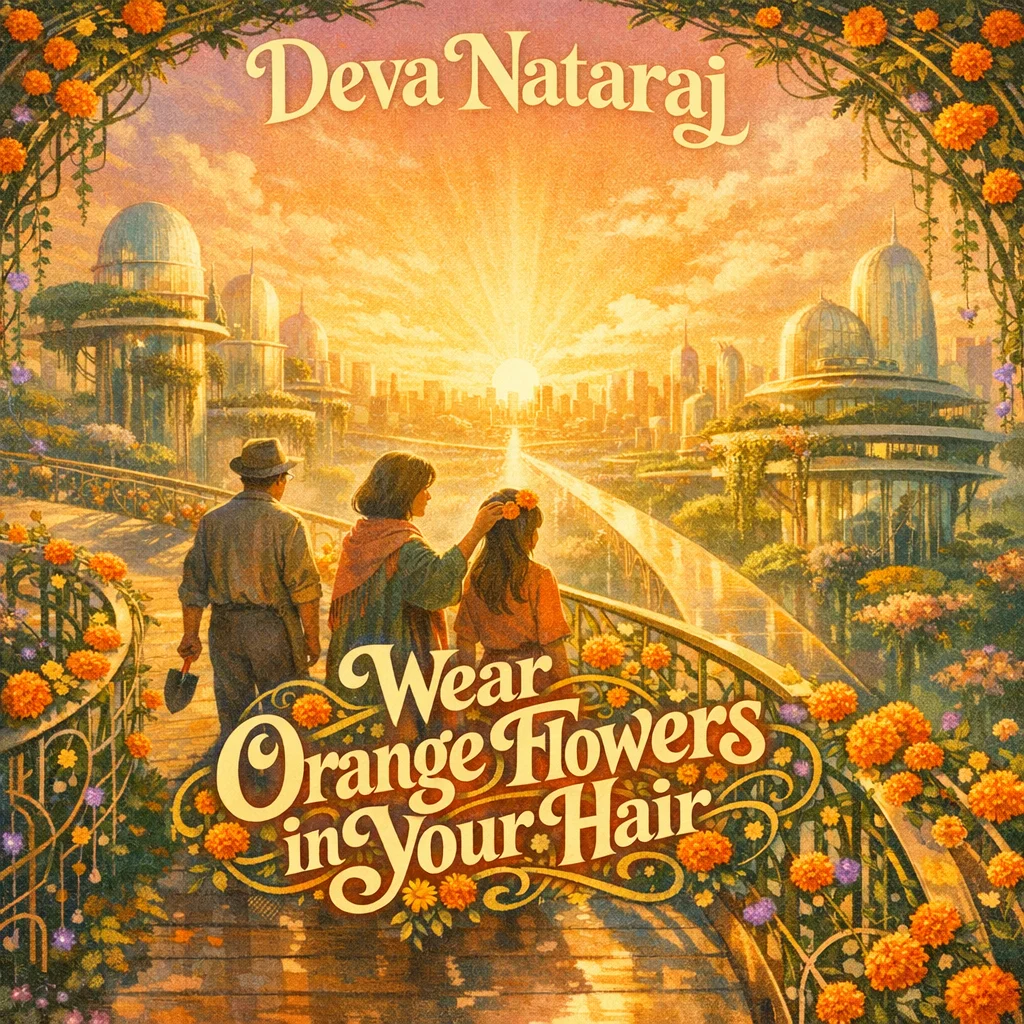
“If you’re coming to the future / Wear orange flowers in your hair / You will meet the gentle people / Building gardens in the air.” The gentle people are still here. They did not vanish when the festivals ended and the mortgages began; they just stopped being visible as a movement and became something less photogenic and more durable – people who build. The song’s second verse widens the lens: “All across the humming country / Such a strange and tender sound / There’s a generation rising / Laying weapons on the ground.” Notice what has changed and what has not. The country hums now with machines rather than guitars, but the gesture is identical: weapons down, hands open.
The philosophy underneath this album holds that violence is the one thing that cannot serve any purpose, because harming someone prevents them from fulfilling the reason they came here. A generation that lays its weapons on the ground is not naive. It is doing the only thing that has ever made a future possible. The flower power dream failed only if you measure it by whether the world was fixed by 1970. Measured by whether the idea survived, it is thriving.
There is a musical argument here too. The song is built on jangling twelve-string guitar and warm organ, the exact sonic vocabulary of the summer it answers, laid over a gentle modern pulse that would not have existed then. The arrangement is the thesis: the old sound is not being imitated or mocked, it is being carried. A listener who knows the era hears the callback immediately; a listener who does not hears a warm, bright folk song with a heartbeat underneath it. Both are right. That is what a seed going underground and coming back sounds like – the same plant, a different season.
Who are the love generation now?
They are the people who marched and the people who code, standing in the same light. The song refuses to let the old and the new be enemies: “Those who marched in old San Francisco / And the children of the code / We are walking the same morning / Down a long and shining road.” That is the album’s whole thesis in four lines. The parents who believed a world could run on love, and the children who are teaching machines to grow food and cure fevers, are not two generations. They are one generation stretched across time.
This matters because the loudest story about technology is a story of coldness – screens, algorithms, isolation. The song imagines something else: the same longing for peace and freedom that filled the parks in 1967 now living in the people who want abundance to mean nobody goes hungry. “Wear your orange flowers proudly / Let them blaze like quiet fire / We were never really finished / We were only dreaming higher.” Dreaming higher is the reframe. The dream did not shrink into nostalgia. It rose, and it took tools with it. (For the fuller picture of who these builders are and what they carry in each hand, see what the hippies actually believed.)
Children of the code is doing double work. On the surface it means the programmers, the people teaching machines to make abundance. Underneath, in the vocabulary of the philosophy this album grows from, reality itself began from a prompt – boundary conditions, a purpose, a word spoken into emptiness – and everyone alive is a child of that code. The marchers and the coders are the same generation not only because they want the same things but because they came from the same source and forgot it in the same way. The song does not press the point. It just lets the children of the code sit beside those who marched as equals on the road.
Why does the dream feel dead when you look around?
Because you are counting the wrong wealth. The song is precise about this: “Count your wealth in golden sunlight / Count the grains of falling sand / Come whoever still remembers / There is love in every hand.” When you tally the world by headlines, markets, and outrage, the love generation looks like a museum exhibit. When you count it in sunlight – in the actual mornings, the actual hands, the actual gardens someone planted – it is everywhere.
There is a quieter reason the dream feels dead, too. Everybody who was young then got old, and the young are taught to distrust their elders’ hope as naivety. The song answers this by widening the invitation: come whoever still remembers. Not whoever was there. Whoever remembers – which means anyone who has ever felt, even for one afternoon, that peace and freedom were not luxuries but the point. The philosophy calls that feeling the compass toward a purpose we cannot name but can sense. You do not have to have been at the march. You only have to still be able to feel what the march was for. (For what it means to say a whole-bodied yes to that feeling instead of half-living around it, see how to fully embrace life.)
What do orange flowers have to do with the future?
They are a signal that you are coming in peace and in joy – the same signal, updated. Orange rather than the old pastel: the color of fire that does not burn, of sunrise rather than sunset. The song ends where it began, with the invitation repeated and one line changed: “If you’re coming to the future / Wear orange flowers in your hair / All the love we thought we buried / Is still breathing everywhere.”
The flowers also mark a refusal to be embarrassed by the past. It is easy to be cynical about the sixties from a distance – to remember only the excess and forget the daring. The song does not defend the excess. It asks you to put the flower back on and walk, which is a harder thing than sneering and a braver thing than nostalgia. Nostalgia wants the summer back. The song wants the future, and it wants you to arrive there recognizable to the gentle people who are already building it.
All the love we thought we buried. That is the confession at the heart of the song, and it is a confession the whole culture could make. We thought we buried it. We told ourselves the sixties were a phase, that idealism was a phase, that growing up meant growing cold. And the song’s answer is not an argument. It is a report: it is still breathing. Go outside. It is in every hand.
The tantric root of this project says the same thing in different words: you do not rise above the world to find the sacred, you dive into it. The flower in the hair is not decoration. It is the refusal to be ashamed of joy. The love generation did not die because joy did not die – it just needed people brave enough to wear it in public again. (For the practice of saying yes to existence as it is, flowers and all, see radical acceptance and saying yes to life.)
We were never really finished
The line to keep is the one that reframes sixty years in a breath: “We were never really finished / We were only dreaming higher.” The love generation did not end. It went home, raised children, learned to code, planted gardens, and kept the candle lit through decades that told it to blow the candle out.
So the question what happened to the love generation has a plain answer. It is walking the same morning as you are, down a long and shining road, and it would like you to come along. Wear the flowers. The gentle people are building gardens in the air, and there is love in every hand.
Frequently Asked Questions
Did the flower power movement actually achieve anything?
It changed what a generation believed was possible, and belief is where every future begins. The song frames the movement not as a finished project but as a seed: “We were never really finished / We were only dreaming higher.” The gardens being built now are that seed grown up.
Who are “the gentle people” in the song?
They are anyone building rather than fighting – the ones who marched decades ago and the children of the code who are teaching machines to grow food and heal. The song puts them on the same road: “Those who marched in old San Francisco / And the children of the code / We are walking the same morning.”
Why orange flowers instead of the classic flowers of the sixties?
Orange is the color of sunrise and of fire that warms rather than burns – the old signal of peace updated for a new morning. The song asks you to “let them blaze like quiet fire,” which is joy worn openly without apology.
Is it naive to still believe in peace and freedom today?
The song’s answer is that it is the opposite of naive: laying weapons on the ground is the only thing that has ever made a future possible. The philosophy behind the album holds that harming others prevents them from fulfilling their purpose, so a generation that chooses peace is choosing the one path that works.
Which Deva Nataraj song is about what happened to the love generation?
“Wear Orange Flowers in Your Hair,” the opening track of The Singularity Love Generation, is written directly about it. It answers the old sixties invitation by pointing it toward the future and insisting that “All the love we thought we buried / Is still breathing everywhere.”