Is It Wrong to Live Outside the System? On Being Called a Degenerate
It is not wrong to live outside the system if you harm no one and owe no one – that is the entire test, and most of the people called degenerates pass it easily. What is actually being judged, when someone gets that label, is not harm. It is disobedience: the refusal to want what you were told to want, in the order you were told to want it. And that refusal, historically, is where every brave tomorrow has come from.
“Beautiful Degenerates,” the fifth track of Deva Nataraj’s The Singularity Love Generation, is a grinning garage-psych anthem for exactly that fringe. Fuzzed bass rumbles under a chorus that takes the insult, polishes it, and wears it like a flower.
Why do people call you a degenerate for living differently?
Because a life that does not need the throne is a quiet argument against the throne. The song opens by cataloguing the accusations and the actual behavior side by side:
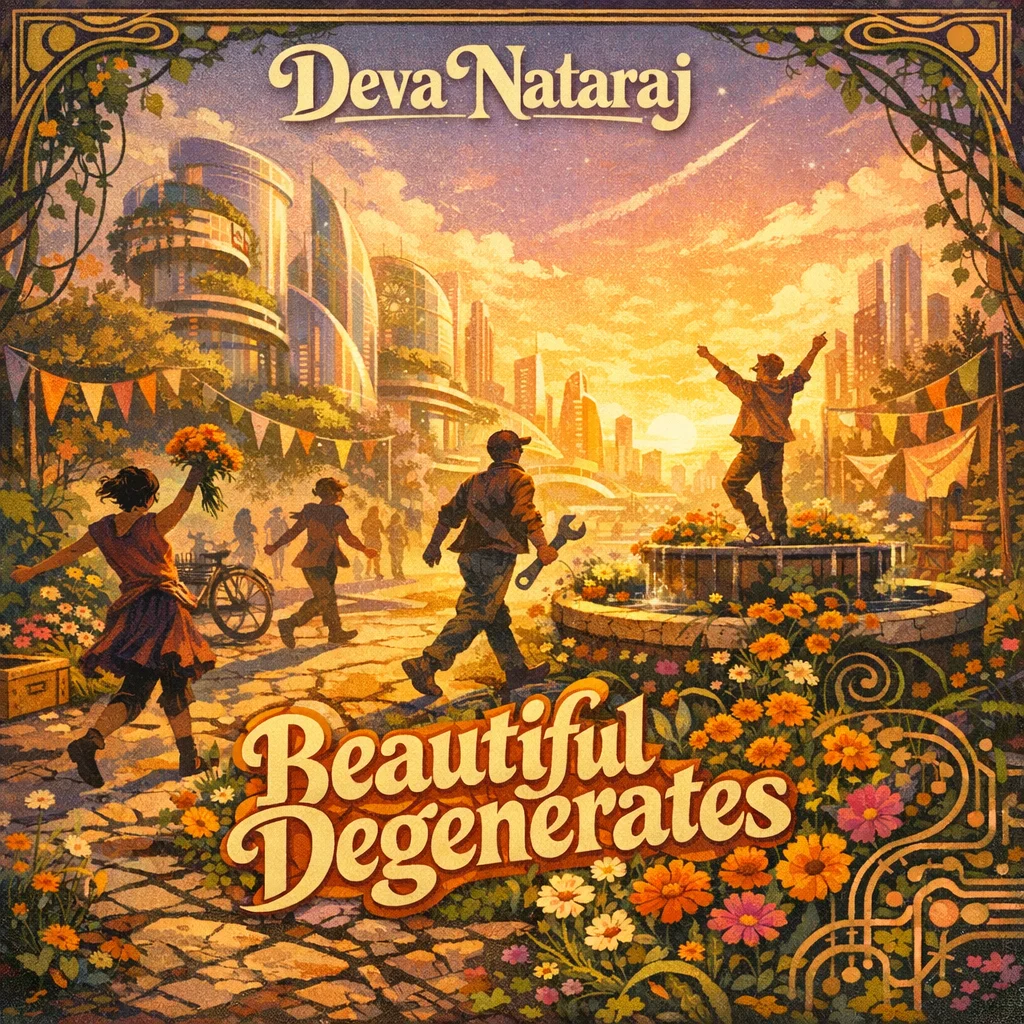
“They say we’re on the skids again / They say we’ve lost the plot / We read our dusty Austrians / And question what we’re taught / We never trusted printed paper / Never bowed to printed kings / We just want to live in peace and / See what freedom brings.” Read what the accused are actually doing: reading, questioning, declining to bow, wanting peace. None of it harms anyone. The offense is entirely in the not bowing.
The philosophy behind this album has a precise standard for what is wrong: harming other life prevents it from fulfilling the purpose it came here for. It adds a second clause that matters here – if we deny others actions that do not harm anyone, we cut off paths that might lead somewhere reality needs. Each of us is always someone else’s “other.” By that standard, the person living quietly off the grid is not the problem. The person insisting they conform is. (For how deeply the need for approval gets wired in, and how to hold a funeral for it, see how to stop people-pleasing.)
The dusty Austrians line rewards a second look. It is the one place the song names what the fringe actually reads, and the joke is that reading old economists is about the least dangerous thing a person can do with an afternoon. The song is not making an argument about economics. It is pointing out how thin the case against the fringe really is – these are people whose great crime is having read something and thought about it. The music grins the whole way through: fuzzed bass, garage-rock swagger, a chorus that sounds like it is being sung with a raised eyebrow. Nobody in this song is wounded by the insult. They are amused by it.
What does “hurting no one, owing no one” actually mean?
It means the only two debts that count are the ones you never took on. The chorus is the song’s whole ethic compressed: “Beautiful degenerates / Dancing out of line / Hurting no one, owing no one / Doing just fine / Beautiful degenerates / Laughing at the throne / Every flower in the gutter / Grows on its own.”
Dancing out of line is the tantric image at the center of this project – the divine dancer who does not need permission to move. And every flower in the gutter grows on its own is the answer to the accusation that the fringe is parasitic. The flower in the gutter is not fed by the throne. It is fed by the same sun as the garden. It just was not planted by anyone’s plan. The song’s wager is that a life can be self-sustaining and joyful without being sanctioned, and that laughing at the throne is not rebellion for its own sake. It is what you do when you realize the throne was never holding you up.
Owing no one deserves its own emphasis. The system’s real grip is rarely force; it is obligation – the debt, the favor, the expectation that you will keep wanting what you were sold. The degenerates in the song have not fought that grip. They have simply declined to take on the debts that make it possible. That is why they can afford to laugh at the throne: there is nothing the throne can call in.
Haven’t the outcasts always been proven wrong?
The song says the opposite, and history tends to agree with the song. “Your grandfather grew his hair out / And they said he’d come to ruin / Now we hold our keys and notions / And they say the same of us, too / But the outcasts and the dropouts / And the dreamers off the grid / Always built the brave tomorrow / That the careful never did.” Every generation’s degenerate becomes the next generation’s founder. The grandfather with the long hair was told he would come to ruin, and instead he raised the people now being told the same thing.
There is a deeper reason the careful never build it. Building a different tomorrow requires you to drop the story you were handed about who you are and what a good life looks like. The philosophy underneath this album calls that story conditioning – borrowed beliefs, inherited moralities, secondhand truths – and says the way through is to drop the borrowed and find the real. The person who cannot drop the story cannot build anything the story did not already contain. The degenerate, by definition, already dropped it. (For what remains of you once the borrowed story is gone, see spiritual unlearning: who are you without your story.)
Notice that the song is not anti-caution as a temperament. The careful are not villains; they are simply not the ones who founded anything. The verse is descriptive, not contemptuous. It reports that the brave tomorrow, every time, was built by the people who were told they had lost the plot – and it invites the careful to notice the pattern before they repeat the sneer at the next generation of long-haired grandsons.
How do I stop caring what they call me?
By letting them call you anything, and answering with what you build. The bridge is almost cheerful about the insults: “Call us wasted, call us crazy / Call us anything you please / The future’s always founded / By the ones who never bend their knees.” The insult is not refuted. It is accepted as the price of admission.
The song’s last chorus turns the whole thing tender, which is the part the sneering never expects. “Beautiful degenerates / Dancing out of line / Take my hand, you gorgeous wreckage / The stars are yours and mine.” Gorgeous wreckage. That is what the fringe looks like from inside: not a movement, not a threat, just people who have been called broken so many times they decided to be beautiful about it, holding hands and looking up. The philosophy behind this project says we came here to live, not to be afraid – and fear of a label is still fear. The people dancing out of line have simply decided the stars are worth more than the throne’s opinion. (For the material side of why so many people are stepping outside the system’s promises, see why everything is more expensive but your salary isn’t.)
And take my hand is the answer to the question underneath is it wrong. The question is really asking whether you will be alone if you step out of line. The song’s reply is a hand extended, and a plural: the stars are yours and mine. Living outside the system was never a solitary act in this song. It is a dance done in company, by people who found each other precisely because they were all dancing out of line.
Every flower in the gutter grows on its own
The line to keep is the one that answers the whole accusation without raising its voice: “Hurting no one, owing no one / Doing just fine.” Living outside the system is wrong only if it harms someone, and it does not. Everything else is the throne being nervous.
The song imagines a fringe that reads, questions, declines to bow, wants peace, and gets called degenerate for it – and that laughs, takes your hand, and points at the sky. You are not wreckage. You are gorgeous wreckage. And the stars were never the throne’s to give.
Frequently Asked Questions
Is it wrong to drop out of the system and live differently?
Not if you harm no one and owe no one – the song makes that the whole test: “Hurting no one, owing no one / Doing just fine.” The philosophy behind the album holds that denying people harmless choices cuts off paths reality may need, so the wrong is in the forcing, not the leaving.
Why does living outside the norm make people so angry?
Because a life that does not need the throne is a quiet argument against it. The song catalogues what the fringe actually does – “We read our dusty Austrians / And question what we’re taught” – and none of it harms anyone. The offense is in the not bowing.
Were the counterculture “dropouts” ever proven right?
Every generation’s degenerate tends to become the next generation’s founder. The song says it directly: “But the outcasts and the dropouts / And the dreamers off the grid / Always built the brave tomorrow / That the careful never did.”
How do I stop caring what people call me for living my own way?
By accepting the label as the price of admission and answering with what you build. The bridge shrugs, “Call us wasted, call us crazy / Call us anything you please” and the last chorus turns tender: “Take my hand, you gorgeous wreckage / The stars are yours and mine.”
Which Deva Nataraj song is about living outside the system?
“Beautiful Degenerates,” from The Singularity Love Generation, is written directly about it – a grinning garage-psych anthem for the peace-loving fringe that gets called degenerate and is busy building tomorrow anyway.