Why Is Everything More Expensive but My Salary Isn't? Inflation and Sovereignty
Everything is more expensive but your salary isn’t because the money you are paid in is quietly losing its meaning – there is more of it every year, and each unit buys less of the same life. You are not imagining the squeeze, and you are not failing at arithmetic. The unit you measure your labor in is shrinking under you, and a wage that stays flat in a shrinking unit is a wage that is falling.
That squeeze is the opening scene of Deva Nataraj’s The Unregulated Juice, and the song that stares at it hardest is “Paper Burn” – a gritty UK drill track that starts with the numbers and ends with a pulse.
Why does it feel like I work the same hours for less life?
Because, measured in what actually matters – food, rent, warmth, time – you do. “Paper Burn” opens exactly where most people are standing, at the kitchen table with a balance that refuses to make sense:
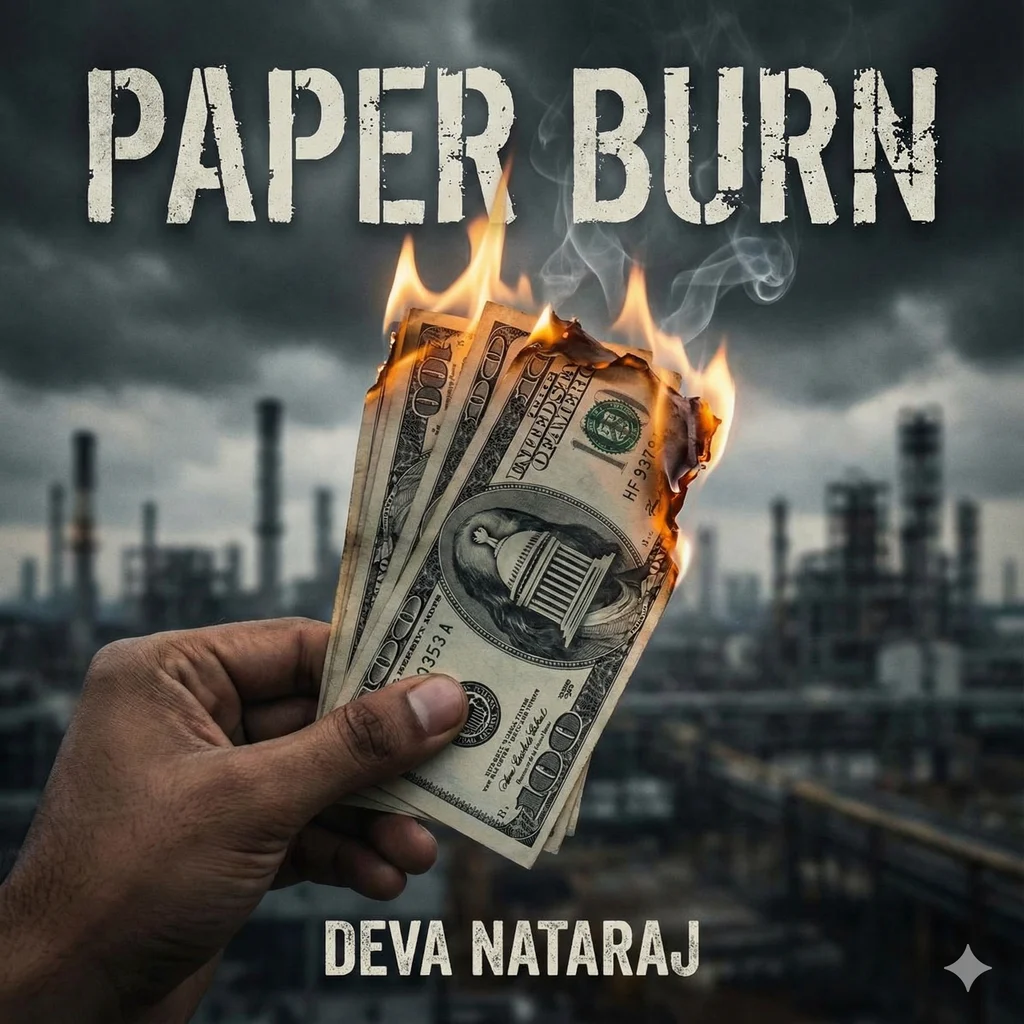
“I’m staring at the balance and the balance is a lie / The price of living’s climbing till it’s touching the sky / My hours stayed the same but the bread got small / While the printers in the basement are papering the wall”. That is the whole mechanism in four lines. Your hours did not change. Your effort did not change. What changed is the paper those hours are exchanged for, and the song names the quiet cost of that change with a phrase worth keeping: “That’s the ghost tax, hidden in the price of the fuel”. No one votes on the ghost tax. It never appears on a payslip. It simply shows up as a smaller loaf and a larger number.
The song refuses to pretend this is fair. “They print a trillion, I lose a chunk of my life / Every dollar in my pocket feels the edge of the knife.” Notice the word life. The lyric is not doing economics. It is pointing out that money is stored hours, and stored hours are stored life, and when the store is diluted, what has been diluted is a piece of your one finite existence. That is why the frustration runs so deep and why a calm explanation of monetary policy never makes it go away. Something real was taken, and it was not just purchasing power. (For why the hours themselves are the scarcer thing, see why time feels more valuable than money.)
Is the game actually rigged, or am I just bad with money?
The song answers without flinching, and then does something more interesting than complaining. The hook lands the accusation flat: “The printer goes brrr, my future goes thin / The game was rigged before I even stepped in / They tax the sweat, they tax the air / They keep us in the cage while we’re gasping for a prayer”. You did not design the rules. You were born into them. Blaming yourself for a system you inherited is a second tax on top of the first.
But the very next lines pivot, and the pivot is the whole album in miniature: “But the more they print, the less I care / 'Cause I’m building something they can’t touch in there”. The song does not argue for a better policy. It relocates the question. There is an “in there” – an interior – that the printer cannot reach, and the more the outer paper thins, the more attention flows inward to what cannot be thinned. Then the refrain that gives the track its name: “Watch the paper burn. / Let the paper burn.”
That is not despair. It is a refusal to let something that was always paper define something that was never paper. The second verse turns the anger into a decision: “But I stopped playing. I stepped off the board. / I’m the only one holding the ledger and the sword / I don’t want the handout, I don’t want the debt / I’m a sovereign soul, haven’t seen nothing yet”. The word sovereign is the spine of The Unregulated Juice. It does not mean rich, and it does not mean untouched by prices. It means that the final accounting of your life is held by you.
What can I actually own that inflation can’t touch?
Only what was never denominated in currency in the first place: your attention, your breath, your body, your skills, your command of yourself. The song is blunt about it: “They can’t regulate the way that I move in the now / I don’t need a master, I don’t need to bow / I’m the hard asset, I’m the gold in the dirt / The only thing I’m owning is the pain and the hurt.”
There is a deliberate honesty in that last line. The sovereign person the song describes is not someone who has escaped difficulty. They own their pain too. Ownership here is not a portfolio; it is responsibility for the whole of one’s experience, the losses included. And the “hard asset” is not something in a vault. It is the person reading this, standing in the dirt, capable of moving, deciding, building. The philosophy running under this project says that we each chose to enter this reality for a purpose we cannot fully remember – and nothing about that purpose was priced in dollars. A currency can be diluted. A reason for being here cannot. (For the album’s fuller answer on what to build in yourself when money thins, see what to invest in when money loses value.)
None of this is a strategy for beating the price of bread. It is something prior to strategy. Before you can respond to a rigged game with any clarity, you need somewhere to stand that the game does not own. The song is describing that ground.
How do I stop the anxiety about money from running my life?
By finding the one transaction no one can intercept. The track breaks from its verses into a spoken passage that is the quiet center of the whole album, and it is startling in its simplicity: “Close the eyes. / Ignore the screen. / The system is out there. / The power is in the lungs. / In. Out. / One breath they can’t tax. / One moment they can’t print. / I am here. / The witness is the only currency left.”
Read that as an instruction, because it is one. The system is out there – real, unfair, loud. The power is in the lungs – also real, and closer. The breath is the one economy that has never been inflated: one in, one out, no middleman, no ghost tax. And the last line borrows a phrase from the artist’s Sacred Amnesia and plants it in a drill track: the witness, the quiet awareness underneath all the reacting, is the only currency left. It cannot be printed because it was never issued. It cannot be taxed because it is not a thing. It is the one who notices the things.
The song’s closing lines carry that all the way home: “It’s all paper. / None of it is real. / Except this moment. / Check your pulse. / That’s the only wealth you got.” This is not a claim that bills do not need paying. It is a claim about where reality lives. Money is a story we agree to tell each other, and the story is being rewritten by people you have never met. Your pulse is not a story. It is happening now, in your wrist, whether or not anyone else agrees. When the anxiety comes – and it will, every time the number on the shelf ticks up – the practice is to drop out of the story and back into the wrist. Not to escape the problem, but to meet it from the only place that is not itself part of the problem. (For the wider practice of returning to this moment when the mind wants to be anywhere else, see how to live in the present moment.)
One breath they can’t tax
The line to keep is the quietest one on a loud record: “One breath they can’t tax. / One moment they can’t print.” Everything is more expensive and your salary isn’t, and that is a real injury to a real life. The song does not ask you to pretend otherwise. It asks you to notice that beneath the balance that lies, there is a balance that cannot lie – the breath moving in and out, the pulse under the skin, the awareness that has been watching the whole rigged game without ever once being for sale.
Let the paper burn. Not the rent, not the bread, not your care for the people who depend on you. Let the story burn – the one that says your worth is the number in the account. What is left when it burns is a sovereign soul, standing in the dirt, checking a pulse. That was always the only wealth you had. It is still yours.
Frequently Asked Questions
Why do prices keep rising while wages stay flat?
Because the supply of money grows faster than the supply of things money buys, so each unit buys less. A wage that stays numerically the same in a diluting currency is a wage that is falling in real terms. “Paper Burn” calls this hidden erosion “the ghost tax, hidden in the price of the fuel” – a cost no one votes on and no payslip shows.
Is it my fault that I can’t get ahead financially?
Not in the way that shame suggests. You were born into rules you did not write, and the song says so plainly: “The game was rigged before I even stepped in”. That does not remove your responsibility for how you respond, but it does remove the second, needless tax of blaming yourself for the design.
What does “sovereignty” mean when money is losing value?
It means the final accounting of your life is held by you, not by the currency. Sovereignty is not wealth; it is self-command – owning your attention, your breath, your skills, and even your pain. The song puts it as “I’m the only one holding the ledger and the sword”.
How do I calm down about money without ignoring reality?
Return to the one thing that has never been inflated: the breath. The song’s spoken passage is a literal instruction – “The power is in the lungs. / In. Out. / One breath they can’t tax.” Meeting a real problem from a steady place is not denial; it is the only way to meet it clearly.
Which Deva Nataraj song is about inflation and rising prices?
“Paper Burn,” the opening track of The Unregulated Juice, is the one written directly about it – staring at a balance that lies, naming the ghost tax, and ending with the only wealth that cannot be printed: “Check your pulse. / That’s the only wealth you got.”