How Do I Stop Reacting to People Who Provoke Me? The Watcher's Point of View
You stop reacting to people who provoke you by shifting your point of view – from inside the anger to the one who is watching the anger rise. The heat still comes, the fist still wants to clench, but when you can see the reaction forming you are no longer the reaction, and a thing you can see is a thing you no longer have to obey. Provocation only works on someone who has collapsed entirely into the feeling it triggers.
That shift is the whole of “The Watcher (POV),” the fourth track on Deva Nataraj’s The Unregulated Juice – a dark trap song that stages a street confrontation in real time and narrates the exact moment a man declines to become someone else’s puppet.
Why do I lose control the moment someone disrespects me?
Because disrespect is aimed at the ego, and the ego reacts faster than thought. The song opens in the middle of exactly that split second:
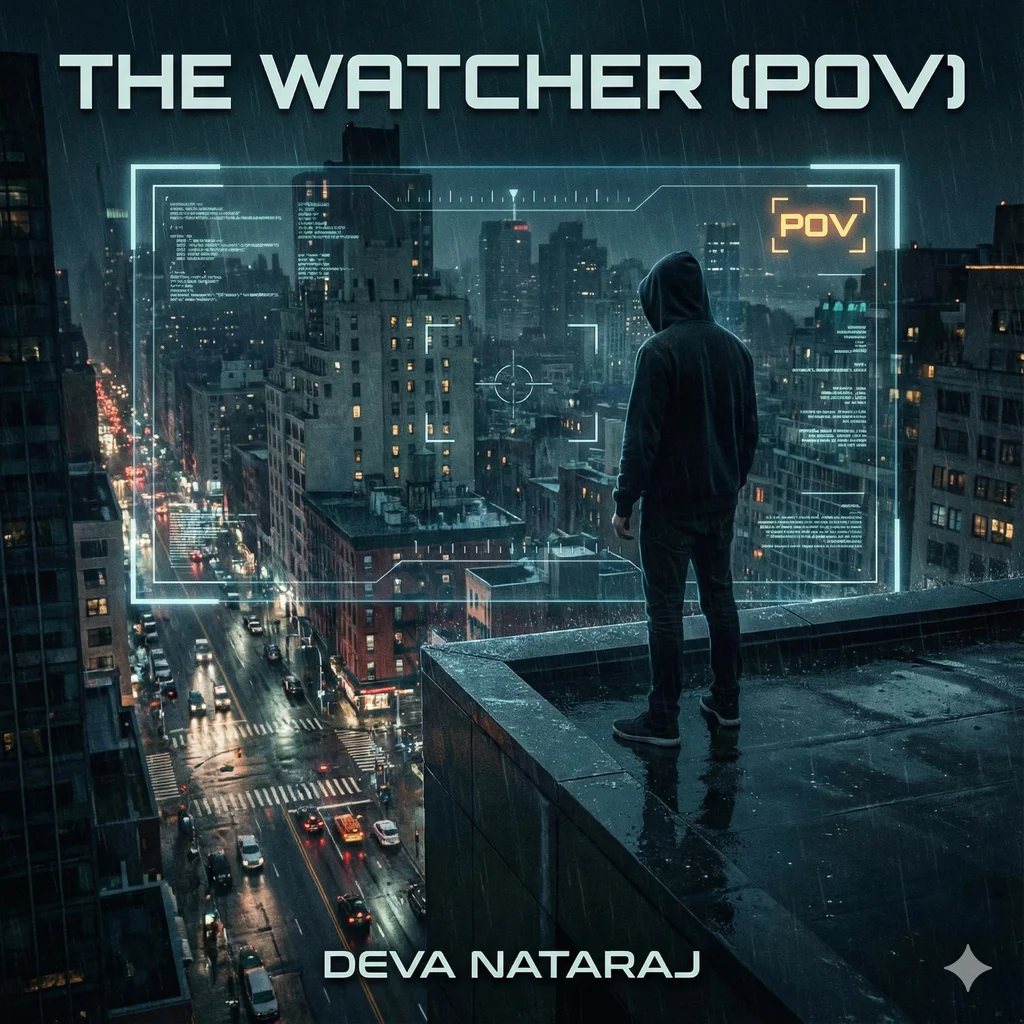
“He’s in my face, yeah, the disrespect is loud / Looking for a victim in the middle of the crowd / I feel the heat rising, the clench in the fist / The old version of me wants to check him off the list”. Every part of the reaction is physical before it is mental – heat, clench, the pull of an old script. This is why “just calm down” never works: by the time you have heard the advice, the body has already voted.
The song does not pretend the urge is not there – the ego is screaming to hit back, hungry for the win, and the lyric names that hunger exactly. What it offers instead is not suppression but a change of camera angle: “But I’m zooming out the camera, looking from within / I see the anger like a storm cloud passing through the sky / I’m the mountain underneath, I don’t even have to try”. A mountain does not fight the weather. It does not need to. The storm passes through and the mountain is still there, and the effort the song describes – “I don’t even have to try” – is the effort of not doing something, which is the hardest kind and the only kind that works here.
What does it mean that the person provoking me is a “puppet”?
It means their hostility is not really about you, and reacting to it makes you a puppet too. The song’s most useful couplet is the one that reframes the whole encounter: “He’s a puppet on a string, pulled by ghosts I can’t see / But if I react to him, then the puppet is me”. The person in your face is being moved by things you cannot see – their own fear, their own history, whatever ghost got into them before they found you. That is not an excuse for them. It is a description of the strings. And the moment you react, the same string runs through you. Two puppets, one ghost.
This is the sovereignty that runs through the whole album, applied to the most ordinary and dangerous moment there is. “The Watcher is awake, and the vision is clear.” The hook makes the vantage point explicit: “This is the POV, looking from the silent height / I’m the third eye blinking in the middle of the fight / You can have the noise, you can have the street / But you can’t have the man who refuses to retreat / Into the reaction, into the cage”. Read that last phrase slowly. The retreat is not from the confrontation. The retreat is into the reaction – which is the cage. Refusing to react is not weakness or withdrawal. It is the refusal to be locked up. (For the meditation practice that this street test is drawn from, see witness consciousness and mindfulness.)
How do I actually stay calm when I’m being provoked?
By practicing the move before the moment, on the smaller provocations that come every morning. The second verse widens the frame from the street to the head: “It’s not just the street, it’s the war inside the head / The voices in the morning that want me back in bed / The anxiety of not enough, the pressure to be great / The system wants me frantic so I’m easier to bait”. A person who is already frantic is bait. The provocation on the street lands so hard because the nervous system was already primed by a thousand smaller provocations – the notifications, the comparisons, the dread. The work of not reacting is mostly done before anyone gets in your face.
The song offers the practice in its plainest form, and it is a practice of language. Instead of saying I am sad, say I am watching sadness move. Instead of I am mad, I am watching anger groove. It sounds like a trick of grammar, but it is a shift of identity: “I’m the screen, not the movie; the witness, not the act / Self-sovereignty is staying in the middle of the fact / That nothing out there can touch what’s in here / When the Watcher is the only one I allow to steer.” The movie can be violent. The screen is not harmed by it. Whatever is happening on the street, in the office, in the family thread, is a movie – vivid, real, and not the same thing as the awareness it plays on. (For finding that steady screen when the emotion is not anger but a whole storm of feeling, see the still point beneath the storm.)
Then the bridge, which is simply breath: “Breath in. / Watch the air. / Breath out. / Watch the air. / The world is a stage. / The people are players. / I am the one sitting in the back of the theater.” The breath is what the body can do while the ego is still screaming. Watch the air go in. Watch it go out. The provocateur is still on stage. You have taken a seat further back.
Isn’t refusing to react just letting people walk over me?
No – it is the only position from which you can respond instead of being triggered. The song is clear that the Watcher is not passive. It “refuses to retreat,” it is “awake,” it “steers.” What it declines to do is hand the steering wheel to a stranger’s ghost. There is nothing weak about a man who can see his own anger arrive, feel it fully, and still decide what his hands do. The weak position is the one where the decision was made for you by whoever shouted first.
Nor is the calm the song describes a cold one, though it uses the word. “Quiet. / Cold. / Free. / ENTER THE FLOW.” The cold is the cool of a clear head, not a closed heart; the very next word is free, and the next track on the album is called “The Flow State.” The philosophy underneath this music holds that every person you meet, including the one provoking you, is on their own sacred journey toward a purpose they cannot remember – and that harming them, or letting them pull you into harm, prevents both purposes at once. Not reacting is how you protect two people’s paths with one act of attention. It is the most active thing in the room.
The song ends with the instruction stripped to its bones: “See the anger. / Don’t be the anger. / See the world. / Don’t be the world. / POV: Sovereign.” That is the whole discipline. Seeing is allowed – encouraged, even. Only being the thing you see is what hands you over. (For what happens when anger is not watched and becomes a loop that feeds itself, see breaking the cycle of anger.)
I’m not the emotion, I’m the space where it lives
The line to keep is the one at the end of the hook: “I’m not the emotion, I’m the space where it lives / The Witness is the power that the silence gives.” You stop reacting to provocation not by feeling less but by locating yourself differently – as the space the anger rises in, the screen the movie plays on, the mountain the storm passes over.
Someone will be in your face again. The heat will rise again; it is supposed to. The question the song asks is only this: when it rises, who is watching? If the answer is no one – if you have collapsed entirely into the clench – the puppet is you. If the answer is I am, then the strings go slack, the theater goes quiet, and the man who refuses to retreat into the cage walks out of it free.
Frequently Asked Questions
Why do I react so fast when someone disrespects me?
Because disrespect targets the ego, and the ego’s reaction is physical before it is mental – heat, a clenched fist, an old script. “The Watcher (POV)” narrates that split second exactly: “I feel the heat rising, the clench in the fist.” Advice to calm down arrives after the body has already voted, which is why the practice has to be trained beforehand.
What does it mean to “zoom out the camera” on anger?
It means shifting from being inside the emotion to being the one who sees it rising. The song’s image is “I see the anger like a storm cloud passing through the sky / I’m the mountain underneath, I don’t even have to try”. The anger is still there and still real; you are simply no longer identical with it, so it cannot steer.
Isn’t not reacting the same as being a pushover?
No. The Watcher in the song is awake, refuses to retreat, and steers – what it declines to do is hand control to a stranger’s provocation. Reacting means someone else made your decision by shouting first. Watching means you keep the wheel and choose your response.
How do I practice this before I’m actually provoked?
Change the grammar of your feelings in small moments: instead of “I am mad,” notice “I am watching anger move.” Then watch the breath, in and out, as the song’s bridge instructs. The street confrontation is only survivable if the practice was already running through the ordinary provocations of the morning.
Which Deva Nataraj song is about not reacting to provocation?
“The Watcher (POV),” the fourth track of The Unregulated Juice, is written directly about it – a street confrontation narrated from the witness’s point of view, ending with “See the anger. / Don’t be the anger. / See the world. / Don’t be the world. / POV: Sovereign.”