How Do I Stop Identifying With My Thoughts? The Witness Is the Only Currency
You stop identifying with your thoughts by noticing that something in you is watching them – and that the watcher is not itself a thought. Every belief, every story, every surge of anger or grief appears inside an awareness that was there before it arrived and remains after it leaves. When you find that awareness and rest in it, thoughts do not stop, but they stop being you. They become weather passing through a sky that was never born and cannot be taken away.
Deva Nataraj’s Sacred Amnesia puts that discovery at the exact centre of the album. “The Witness Is the Only Currency” is the sixth track, a dynamic progressive metal piece about the moment of seeing clearly for the first time, when every mask is stripped and what remains is the one thing that survives the self.
What is left when I strip away all my thoughts and stories?
Something watching. “The Witness Is the Only Currency” begins with a subtraction and then asks the only question that matters:
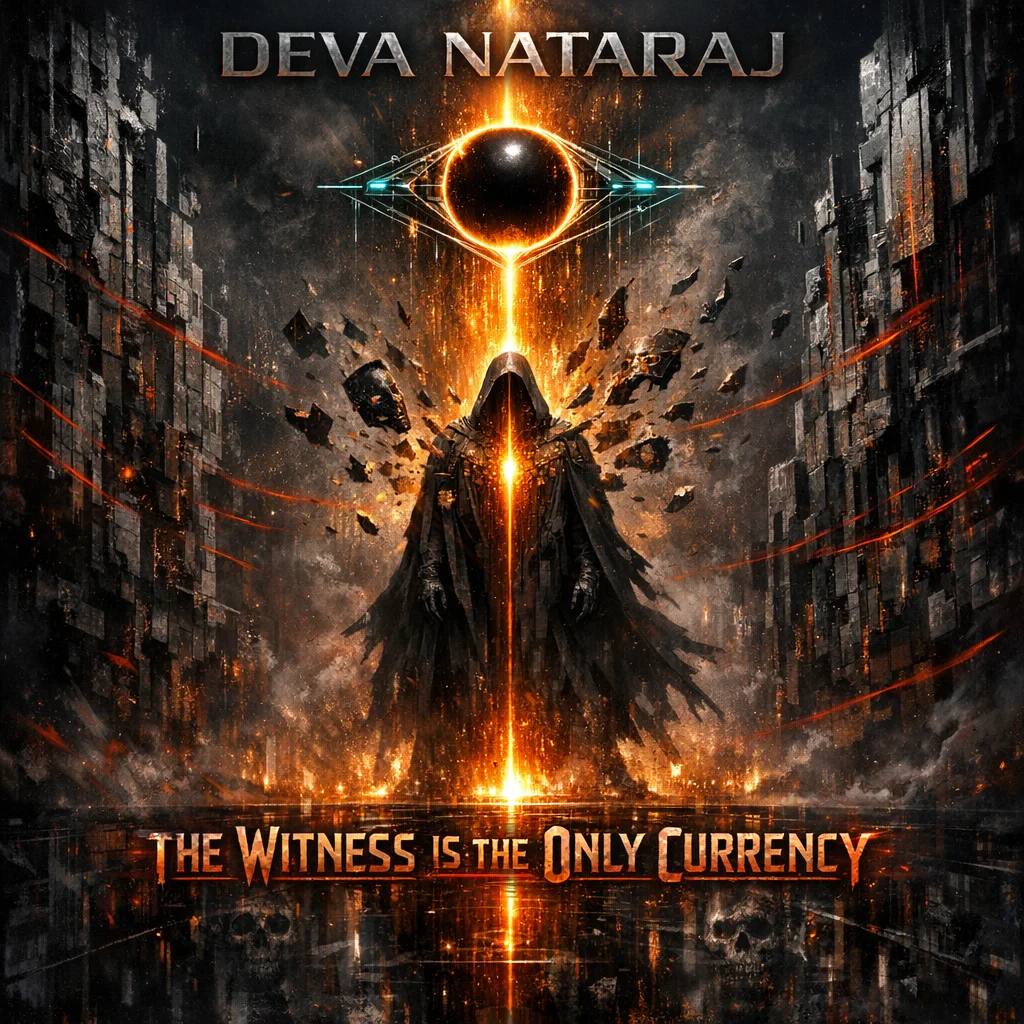
“Strip the name, strip the story / Strip the years of accumulated glory / What remains when every mask is gone? / What remains when every role is done?”. Most people never run this experiment because they assume the answer is nothing: take away the name, the history, the achievements, the roles, and you are left with a void. The song runs it and finds the opposite. “There is something watching / That was never born / Something underneath the weather / That has never worn a storm”. Underneath the weather of thought there is something that has never worn a storm, never been soaked, never been altered by a single thing it observed. The album’s philosophy calls this the witness: awareness itself, observing without grasping, present without judging. It is not a better thought. It is the space thoughts appear in.
Then the chorus makes its claim, which is also the title: “The witness is the only currency / The only thing they cannot take / The witness is the only currency / The only thing that doesn’t break”. Everything else you have can be taken. Money, health, reputation, relationships, even your memories and your certainties. The witness cannot be taken because it was never acquired. You brought it. This is the reason the track sits at the heart of an album about a soul that chose to forget its divinity: through every mask and every role, one thing was never forgotten because it was never a thing to remember. It was the rememberer. (For how this same still awareness sits beneath emotional storms, see the still point beneath the storm.)
How can I not be my thoughts when they feel so much like me?
Because a feeling of identity is itself just another thought, and you can watch it too. The song’s second verse is the most direct instruction on the album, and it works as a practice you can do while reading it: “You are not your anger / You are not your grief / You are not the narrative / You are not the belief / You are the awareness / That contains them all / The space between the lightning / And the thunder’s fall”. Take any one of those. Anger arises; notice that you can see the anger, which means there is a seer, and the seer is not angry. The narrative runs, the story of who you are and what was done to you; notice that the story is being told to someone, and the someone is not the story. The point is not to suppress the anger or rewrite the narrative. It is to find the one who is aware of them and discover that you have been that all along.
The image of the space between the lightning and the thunder is exact. Lightning strikes: the thought or the feeling. Thunder follows: the reaction, the identification, the story about the thought. Between them is a gap, and the gap is where you live. Most of the time the gap is so short that lightning and thunder feel like one event, and you are the thunder before you know it. Witnessing does not eliminate the lightning. It widens the gap. In that space there is a choice, and the tantric principle behind the album says the choice does not need to be forced: what is seen clearly transforms on its own, without a fight. (For the practical training that widens the gap, see witness consciousness and mindfulness.)
Isn’t the witness just another thought about myself?
No, and the song answers the objection with a line that dissolves the whole seeker-and-sought problem: “The seeker and the sought / Are the same pair of eyes / The observer and the observed / Were never otherwise”. If you look for the witness as an object, you will never find it, because you are looking with it. The eye cannot see itself as something in its own field of vision. This is why people meditate for years hunting a special state called witnessing and miss the obvious: the hunting is being watched, right now, by the thing they are hunting for. The philosophy behind the album says that when you look within and are present, you are without anything permanent. There is no fixed self-object in there to find. There is only the seeing.
That is not a loss. It is what makes the witness unbreakable. A thought about yourself can be argued with, damaged, replaced; every mask on the album is exactly that kind of thought, forged and then cooled. Awareness cannot be argued with because it is not a position. It is the ground the argument happens on. And it is why the song ties the witness to presence so tightly: “This moment - this is the only thing / That is certainly true / Not the past you carry / Not the future pulling you”. The past is memory, a thought. The future is anticipation, a thought. The witness lives only in the moment, because the moment is the only place anything is actually seen. Identify with thoughts and you live in the two places that do not exist. Rest in the witness and you live in the one that does.
How do I actually practice this in daily life?
By being present in the ordinary, which is where the song goes in its bridge: “Be present when you hold / What you think you own / Be present when you work / In the field you’ve sown / Be present with the ones / You won’t get back again / The witness doesn’t flee from joy / The witness doesn’t flee from pain”. Notice that none of this happens on a cushion. The practice is holding a thing you own and being fully there for the holding, working a field you planted and being fully there for the work, sitting with a person you will one day lose and being fully there for them. Witnessing is not detachment from life; it is the most complete attendance to it. The philosophy behind the album insists that renunciation is not a shortcut to presence and that you do not have to give up anything to find this. You have to be there for what you already have.
The last two lines of that passage are the ones to memorise. The witness does not flee from joy and does not flee from pain. Thought-identification always flees: it grabs at joy to keep it and pushes at pain to end it, and the grabbing and pushing are what make both unbearable. The witness simply watches both arrive and watches both go. That is the difference between a life ruled by reactions and a life that can hold anything. In practice it is as small as this: when a thought says I am furious, notice there is fury, and here is what sees it. When a thought says I am worthless, notice there is that story again, and here is what hears it. The story may not change today. Your relationship to it changes immediately. (For the same move applied to someone provoking you on purpose, see how to stop reacting to provocation.)
The song’s final chorus reveals where the witness came from, and it is the album’s cosmology in one couplet: “The witness is the only currency / You brought it here from somewhere else / The witness is the only currency / The one thing that survives the self”. In the philosophy behind the record, we entered this reality from elsewhere and forgot nearly everything. The one thing that crossed the gate intact is the awareness itself. It is not made of this world’s material, so this world cannot break it. It is the currency you arrived with and the currency you leave with. Everything you identify with in between is, by comparison, borrowed.
You are the awareness that contains them all
The line to keep from “The Witness Is the Only Currency” is the one that ends the confusion: “You are the awareness / That contains them all”. You stop identifying with your thoughts not by silencing them but by locating the one who hears them, the something watching that was never born and has never worn a storm.
Thoughts will keep coming. Anger, grief, narrative, belief. Let them. They are lightning, and you are the space before the thunder. That space is the only thing they cannot take, the only thing that doesn’t break, and the one thing that survives the self. You brought it here from somewhere else. It is yours.
Frequently Asked Questions
How do I stop identifying with my thoughts?
By noticing that something in you is watching them and that the watcher is not itself a thought. “The Witness Is the Only Currency” puts it directly: “You are not your anger / You are not your grief / You are not the narrative / You are not the belief / You are the awareness / That contains them all”. Thoughts keep coming; they stop being you.
What is the witness in spiritual terms?
The witness is awareness itself, observing without judging or grasping. The song describes it as “There is something watching / That was never born”, underneath the weather of thought, that “has never worn a storm”. It is not a special state or a better thought; it is the space every thought and feeling appears in, and it is what you are when every mask and role is stripped away.
Why is the witness called the only currency?
Because it is the only thing that cannot be taken and does not break. Money, reputation, health, memories, and certainties can all be lost; awareness was never acquired, so it cannot be removed. In the album’s cosmology you brought it here from somewhere else, and it is the one thing that survives the self.
Is witnessing the same as being detached from life?
No. The song’s bridge is all about ordinary presence: “Be present when you hold / What you think you own / Be present when you work / In the field you’ve sown”. Witnessing is the most complete attendance to life, not withdrawal from it. It does not flee from joy or from pain; it lets both arrive and both pass while you remain.
Which Deva Nataraj song is about not identifying with your thoughts and the witness?
“The Witness Is the Only Currency,” the sixth and central track of Sacred Amnesia, is written directly about it: the stripping of name and story, the awareness that contains anger, grief, narrative, and belief, and the one currency you brought here from somewhere else that cannot be taken.