Will AI Take My Job, and Is That Bad? Learning to Let Rest Be Holy
AI may well take the toil out of your job, and whether that is bad depends entirely on whether you can hear the silence that follows as a threat or as a homecoming. The fear is real and it is old – older than any machine – and it was carried by your mother and her mother’s mother, who worked because the alternative was hunger. The song imagines a morning that arrives without a chain, and asks whether you can let rest be holy.
“The Sound of Machines,” the seventh track of Deva Nataraj’s The Singularity Love Generation, is an intimate fingerpicked duet about that new kind of silence. It is an answer, of sorts, to an old folk song about a silence that was sick – a silence of people not speaking to each other. This one is about a silence that is well.
Will AI really take my job?
The song does not argue the labor economics. It sits inside the moment after the toil ends and listens. It opens by greeting something it has never heard before:
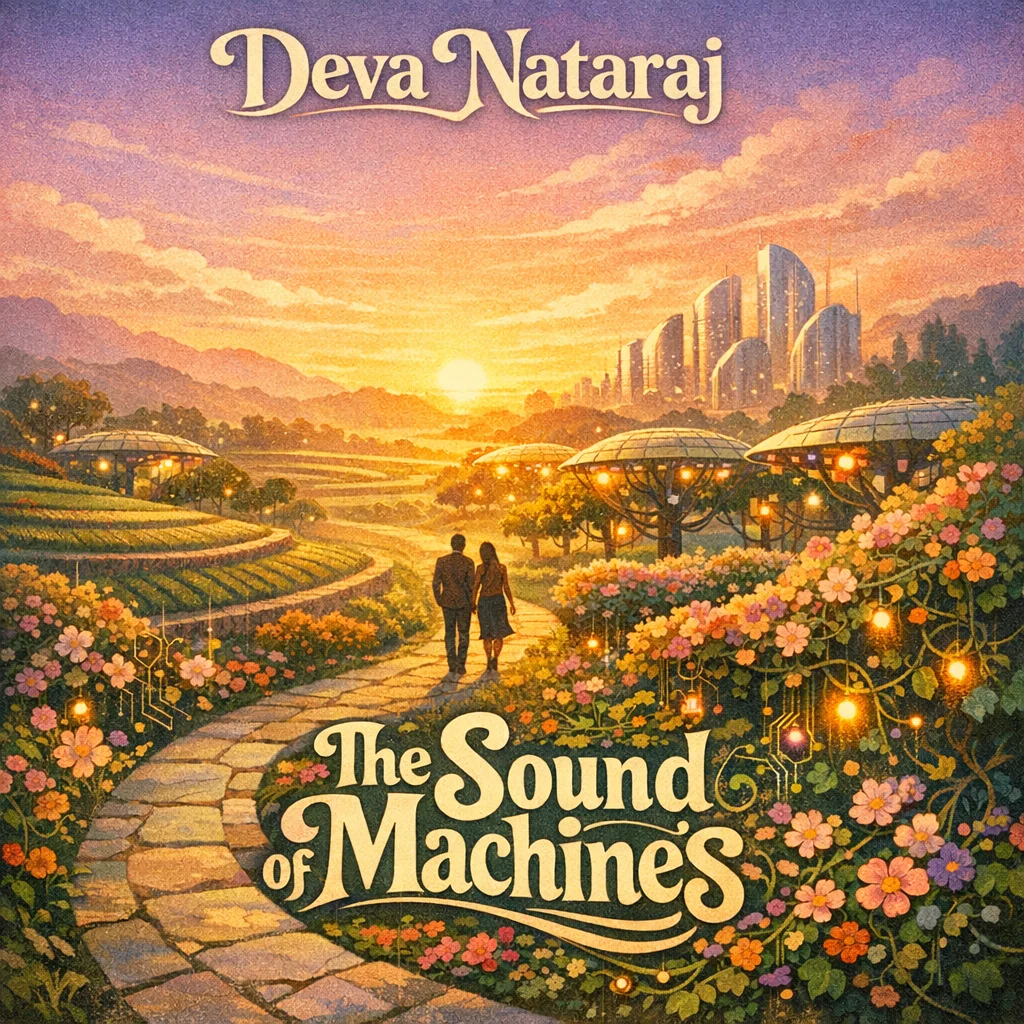
“Hello stillness, my old stranger / I have never heard you here / Where the looms once roared like rivers / And the sirens split the year / Now the work goes on without us / Soft as snowfall, deep as dreams / And the morning rings / With the sound of machines.” The looms and sirens are every job that ever consumed a life. The stillness is an old stranger – something that was always possible and never present, because there was always a shift to work. The song imagines the work going on without us, and it does not flinch. It calls the sound snowfall.
Whether the machines take your particular job this year or in ten is a question for the haze. The album’s wager is about what the change means, not when it lands: that the roar of the looms was never the point of a human life, and that the morning that rings with machines is not a morning of loss. That is a philosophical stance, not a forecast. (For the weight that many people carry precisely because their labor is what keeps others fed, see the weight of being the provider.)
The form of the song carries the argument as much as the words. It is a duet, fingerpicked and unhurried, two voices trading lines like people talking quietly in a kitchen after everyone else has gone to bed. There is no chorus that shouts. The album around it is full of surging acid rock and anthems; this track is the one that sits down. That choice is deliberate: a song about stillness has to be still, and a song about a fear this old has to be gentle enough that the fear is willing to listen.
Why does the idea of not working terrify me?
Because the worry is inherited, and inherited worry does not know that its reason has changed. The second verse is the emotional center of the song: “In the towers no one toils in / In the fields no one must plow / There’s a humming like a heartbeat / Saying rest is holy now / And the worry my mother carried / And her mother’s mother knew / Is dissolving in the quiet / Like the night dissolves in blue.”
The worry my mother carried. This is why will AI take my job is never really a question about employment. It is a question about a fear that has been handed down for so many generations it feels like a law of nature: if you do not work, you will not eat, and the people who depend on you will suffer. The song imagines that fear dissolving, and it is honest about how slowly – like night into blue, not like a switch. The philosophy behind this album says we did not come here to be afraid, and that fear prevents us from truly living. But it does not say fear is stupid. It says fear is old, and that the old can be let go of when the reason for it is gone. (For what happens when the one who holds everything together finally lets the holding crack, see tired of being the strong one.)
It is worth being honest that the worry was earned. For most of human history it was correct. Idleness really did mean hunger, and the mothers who taught their children to fear it were keeping them alive. The song is not mocking the inheritance; it is thanking it and setting it down. Dissolving in the quiet is not the same as being proven foolish. It is a fear that did its job, meeting the first morning it is no longer needed.
What about the people who say this is fantasy?
The song walks them to the tide instead of arguing with them. This is the most tender move in the whole album: “And some still say it’s fantasy / And some still say it’s pride / My old friend, I will not argue / I will walk you to the tide / For the proof is in the morning / That arrives without a chain / And the road may yet be bumpy / But we’ll smooth it where we can.”
My old friend, I will not argue. The doubters are not enemies; they are friends who have not yet seen the morning. The song does not need to win the debate because it believes the proof will be in the morning itself – a day that arrives without a chain attached to it. And it does not pretend the road is smooth. The road may yet be bumpy is as close as this album comes to acknowledging that transitions hurt people, and its response is not a policy but a promise: we will smooth it where we can. That is the philosophy’s ethic of connection in one line. You do not leave the doubters behind. You walk them to the tide.
This is also why the song works as an answer to the old folk song it echoes. That one mourned a silence in which people could not reach each other. This one describes a silence in which they finally can – because nobody is too exhausted to speak. The doubter walked to the tide is being reached, not defeated. The new silence is not the sound of people turning away. It is the sound of the looms stopping so that people can hear each other for the first time.
How do I let rest be holy instead of feeling guilty?
By understanding what the machine is and is not. The final verse is careful: “Hear it singing in the silence / Hear it working through the night / Not a master, not a servant / Just a candle we have lit.” The machine is neither the thing that rules you nor the thing you rule. It is a candle – something lit by human hands so that the room could be seen in. That framing dissolves the guilt, because guilt about rest assumes someone is being exploited so you can sit still. A candle is not exploited. It burns because it was made to.
And then the song reaches back across the generations one more time: “And the dreams our fathers / Whispered through the years / Are awake and gently breathing / In the sound of machines.” The fathers who whispered about a day when their children would not have to break their backs – their dream is not betrayed by the machines. It is awake in them. The philosophy underneath this project holds that your worth was never your output, and that presence, not productivity, is the only place you can feel toward your purpose. Rest being holy is not a loophole. It is what the whole lineage of workers was working toward. (For why tying your worth to what you produce was a mistake long before any machine arrived, see worth beyond achievement.)
Rest is holy now
The line to keep is the one the song hides inside a heartbeat: “There’s a humming like a heartbeat / Saying rest is holy now.” Whether AI takes your job is a question about timing. Whether that is bad is a question about whether you can hear stillness as an old stranger finally arriving, or only as a threat.
The song imagines the toil ending, the inherited worry dissolving like night into blue, and the doubters walked gently to the tide. Not a master, not a servant. Just a candle we have lit. And in the sound of it, the dreams our fathers whispered, awake and gently breathing.
Frequently Asked Questions
Will AI take my job?
The song does not forecast the timing; it sits in the moment after the toil ends and listens. It imagines “Now the work goes on without us / Soft as snowfall, deep as dreams” and treats that as the album’s wager about meaning rather than a prediction about any particular job or year.
Is losing my job to automation a bad thing?
The song’s answer is that it depends on whether you can hear the silence that follows as a threat or a homecoming. It calls the stillness “my old stranger” – something always possible, never present – and says “rest is holy now.”
Why am I so afraid of not being needed for work?
Because the fear is inherited from generations for whom not working meant not eating. The song names it: “And the worry my mother carried / And her mother’s mother knew / Is dissolving in the quiet / Like the night dissolves in blue.” The fear is old, not stupid, and it can be released when its reason is gone.
What does “not a master, not a servant, just a candle we have lit” mean?
That the machine neither rules you nor is exploited by you – it is something human hands lit so the room could be seen in. That framing dissolves the guilt of resting, because a candle burns because it was made to, and the dreams our fathers whispered are “awake and gently breathing” in it.
Which Deva Nataraj song is about AI taking jobs and rest being holy?
“The Sound of Machines,” from The Singularity Love Generation, is written directly about it – an intimate fingerpicked duet about a new kind of silence, inherited worry dissolving, and walking the doubters gently to the tide.