What Will Humans Do When AI Does All the Work? Nothing Left but Love
When AI does all the work, humans will do the one thing work was always a detour toward: find each other. Every engine, every ladder, every gold rush was a bridge to a kiss we kept postponing because there was a harvest to bring in. When the harvest picks itself, the postponement ends, and what is left is not emptiness but the thing underneath the wanting – somebody to love.
That is the answer “Nothing Left but Love” gives, the fourth track of Deva Nataraj’s The Singularity Love Generation. It is a surging acid-rock song driven by a powerful female voice, and it plays like a search – not for a job, not for a purpose you can put on a business card, but for the person you were always looking for while you worked.
What will people do when there’s nothing left to do?
The song answers with a question of its own, asked three times, and each time it gets more pointed. It begins by imagining the end of scarcity as plainly as possible:
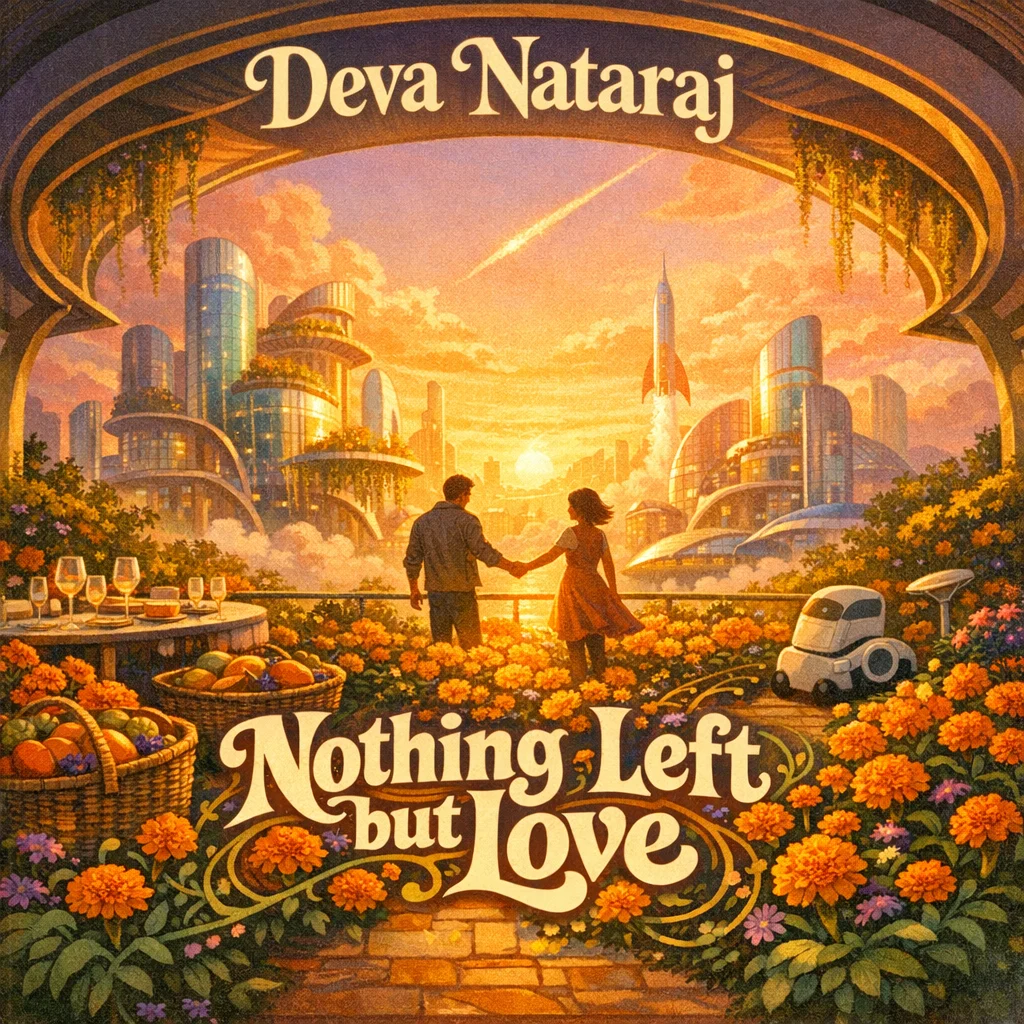
“When the harvest picks itself / And the table sets its own / When the fever has a cure / And nobody waits alone / Tell me what will you be hungry for?” And again: “When the houses build by morning / And the lights cost less than air / When the machines hum in the basement / And there’s plenty everywhere / Tell me what will you be reaching for?” Hungry for. Reaching for. The song does not pretend that hunger and reaching go away. It asks what they attach to once survival is no longer the answer.
The fear behind the question – what will humans do – assumes that work was the source of meaning. The philosophy behind this album says something different: purpose is genuinely our own, chosen before we came here, and we cannot know it directly but can feel toward it through presence. Work was one place people felt toward it. It was never the only one. When the machines hum in the basement, the feeling toward purpose does not stop. It just stops being confused with a paycheck.
It helps to hear how the song asks. This is not a gentle ballad about leisure. It is surging acid rock, driven by a female voice that sounds like it is hunting for something, and the three questions land as demands rather than musings. Tell me. The song is impatient with the polite version of the future in which everyone is vaguely content. It wants to know, specifically, what you will be hungry for, because it suspects most people have never asked and would not like the honest answer: that they were hungry for each other the whole time and used the harvest as an excuse.
Isn’t a life without work a life without meaning?
Only if you believed the ladder was the point. The song’s third verse looks at the old measures of a life and finds them lying quiet: “All the gold we used to die for / Lying quiet in the ground / All the corner-office ladders / Standing empty in the town / And your heart still beating like a drum.” The gold is still there. The ladders are still there. Nobody died for them, in the end, and the heart kept beating anyway.
This is where the song lands its hardest reframe. It does not say the work was meaningless. It says the work was aimed at something it never quite named: “Don’t you know that all the engines / Were just bridges to a kiss? / Every circuit, every satellite / Was always after this / Two people in a garden, finally home.” Every satellite was after this. The whole technological project, the song imagines, was a very long and roundabout way of buying two people an afternoon in a garden with nothing to do but be together. If that sounds small, it is only because we have spent so long calling the bridge the destination. (For the men in particular who built their identity on being useful and have no one to say the true thing to, see male loneliness and silence.)
Consider what finally home implies. Home is not somewhere you arrive by working harder; it is where you were before the working started, and where the working was supposed to return you. The song’s garden is not a reward for the engines. It is what the engines were built to make room for, and it was there all along – two people, no task between them. If that sounds like an anticlimax after satellites and circuits, the song’s reply is that the satellites were the detour and the garden was the point. Abundance does not invent a new purpose for humans. It removes the excuse for postponing the old one.
Why do I feel anxious about not being needed?
Because you learned to keep score of yourself, and the scoreboard is about to go dark. The chorus turns that anxiety into an instruction, delivered with real urgency: “When the wanting’s over / And the work is finally done / You better find somebody to love / When there’s nothing left to fight for / Underneath the patient sun / You better find somebody to love.” You better. It is a warning as much as an invitation. When the fight is gone, the people who only knew how to fight will be lost – unless they learn the other thing in time.
The philosophy underneath this project holds that connection is the reality that matters. Even in a simulation, experiencing together is what is meaningful; we would not have come to a reality where interaction happens if we did not want it. Being needed at work was a rationed, indirect form of connection – someone required your output, and that felt like being seen. The song’s wager is that the direct form was available all along, and that a world without scarcity simply removes the last excuse for not reaching for it. (For why your worth was never the number on the scoreboard, see worth beyond achievement.)
The anxiety about not being needed also has a gentler reading. Being needed is a way of being held in place – someone’s dependence on you tells you where to stand. Without it, you have to choose where to stand, which is frightening in the way freedom is always frightening. The song does not pretend otherwise. It just points out that the choice was always the real task, and that work was letting you avoid it.
How do I prepare for a world where work is optional?
By practicing now the thing the song says will be all that remains. You do not have to wait for the harvest to pick itself to find out whether you know how to love somebody when there is nothing to fight for. That test is available today, on any evening when the work is done and you sit across from someone and have no task to hide behind. Most people fail it quietly, by picking up the phone. The song asks you to notice the patient sun instead.
There is a practical honesty in this. Many people who say they long for a life without work have never spent a whole free day without reaching for something to be busy with. The song’s future is not a threat to them, but it is a test, and the test can be taken early.
The ending is not subtle, and it should not be. The voice drops the philosophy and simply calls: “Find somebody / Find somebody / Find somebody to love!” That is the whole preparation. A world of plenty does not need you to be productive. It needs you to be present, embodied, willing to be found. The tantric root of this project says the body is the temple and the moment is the altar; the song says the garden is where you were always headed and the machines just cleared the path. Learn to sit in it now. (For the practice of saying a whole-bodied yes to life instead of just getting through it, see how to fully embrace life.)
All the engines were just bridges to a kiss
The line to keep is the one that reveals what the whole project was for: “Don’t you know that all the engines / Were just bridges to a kiss?” When AI does all the work, humans will do what the work was always a detour around. They will find each other.
The song imagines the wanting over, the work done, the gold lying quiet, and one heart still beating like a drum. That heartbeat is the answer to what will humans do. It was never going to be idle. It was going to look for somebody to love, and finally have the time.
Frequently Asked Questions
What will people do for meaning when AI does all the work?
The song’s answer is that meaning was never really in the work – it was in what the work was reaching toward. “Don’t you know that all the engines / Were just bridges to a kiss?” When the harvest picks itself, the reaching does not stop; it finally lands on people instead of tasks.
Will a world without scarcity feel empty?
Only if you mistook the ladder for the point. The song imagines “All the corner-office ladders / Standing empty in the town / And your heart still beating like a drum.” The gold and the ladders go quiet, but the heart does not, and the heart was always the real appetite.
Why does the idea of not being needed make me anxious?
Because being needed at work was an indirect way of being seen, and losing it feels like losing connection. The chorus treats this as urgent: “When there’s nothing left to fight for / Underneath the patient sun / You better find somebody to love.” The direct form of connection was available all along.
How can I prepare for a future where work is optional?
Practice now the thing the song says will remain: sit with someone when the work is done and there is no task to hide behind. The song ends with a plain instruction, “Find somebody / Find somebody / Find somebody to love!” That is the whole preparation.
Which Deva Nataraj song is about what humans will do when AI does the work?
“Nothing Left but Love,” from The Singularity Love Generation, is written directly about it – a surging acid-rock track that imagines the end of scarcity and finds only one thing left standing: the search for somebody to love.