Why Do I Feel Lonely With a Thousand Online Friends? Cowards Die Connected
You feel lonely with a thousand online friends because being connected and being present are not the same thing, and only presence ends loneliness. A feed full of contacts keeps you wired to other people’s thoughts while your own breath goes unwitnessed, and the ache you feel is not a shortage of people. It is a shortage of you showing up, bare and unarmored, in a moment that is actually happening. The cure is not more connection. It is courage.
Deva Nataraj’s Sacred Amnesia takes this on in its fourth track, “Cowards Die Connected,” a dark melodic death metal song about fear as the true killer – not the fear of dying, but the fear of living, of the raw present moment, and of the silence underneath the noise.
Why does being constantly connected leave me feeling so alone?
Because the connection is a hiding place, and nobody can reach you where you are hiding. “Cowards Die Connected” opens with a line taken straight from the philosophy the whole album stands on:
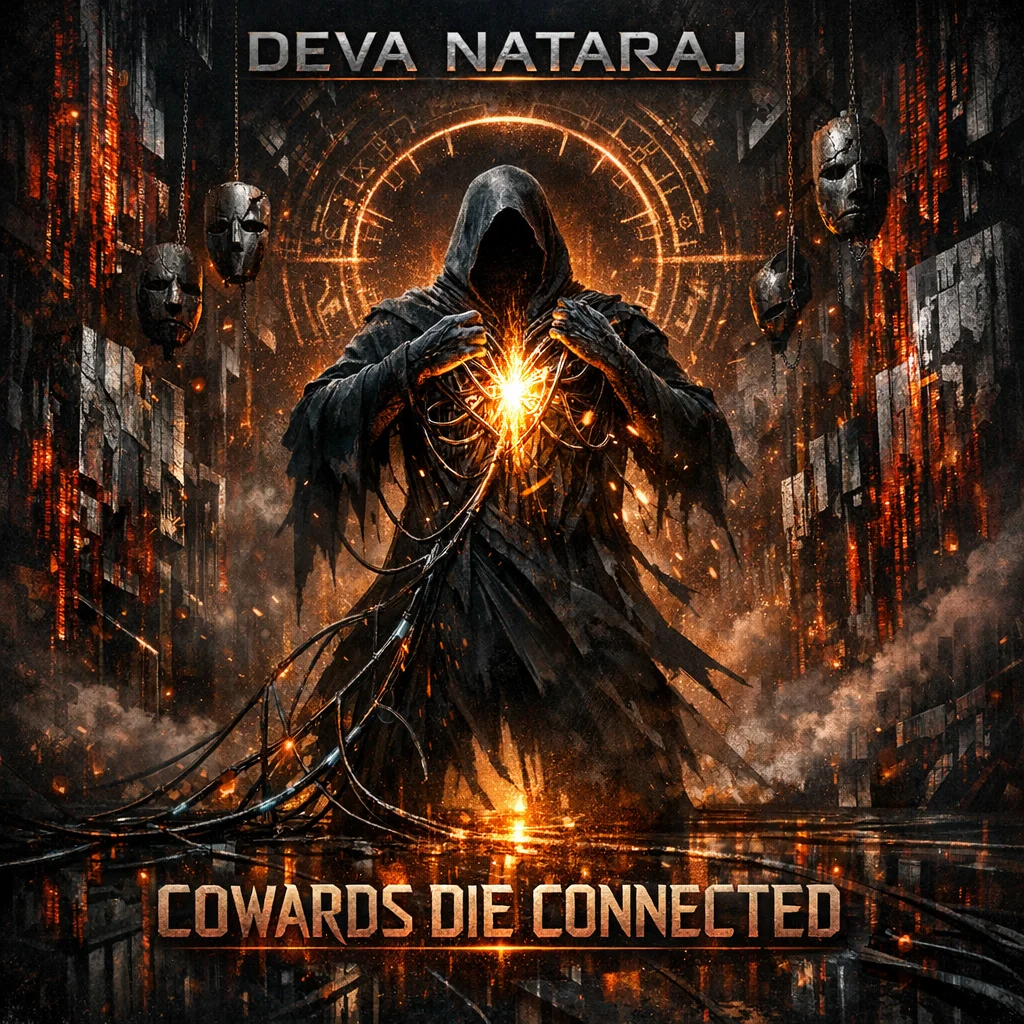
“We did not come here to be afraid / We came here to live / But the signal’s buried in the noise / And the noise is all we give”. In the album’s cosmology, we chose to enter this life, deliberately and at a cost, in order to live it fully. Fear was never part of the plan; it is the thing that gets in the way of the plan. And the feed is fear’s favourite furniture. It lets you feel connected while keeping every actual encounter at a safe distance: no face to read, no silence to sit through, no moment in which someone might see you shake.
The chorus names the result without mercy: “Cowards die connected / Wired to the feed but missing every breath / Cowards die connected / A thousand friends and still alone at death”. The word cowards is not an insult here; the song uses it the way the philosophy behind the album uses it, to mean anyone who has let fear decide how much of their life they will actually show up for. That describes nearly everyone at some point. The point is not to shame the coward. It is to show that the connection was never the cure for the loneliness, because loneliness is what it feels like when your breath goes unwitnessed, and no number of contacts can witness a breath you are not taking.
What am I actually afraid of?
Not death. The song is unusually precise about this: “The fear is not of dying - that’s the easy part / The fear is of the moment, bare and bright / Of standing in the present with no armor on / And letting yourself shatter in the light”. Almost everyone assumes the deep fear is of the end. The song says the deep fear is of the middle: of a present moment so vivid and undefended that the version of you that manages everything cannot survive it. The feed protects you from that moment. It gives your hands something to do and your mind something to chew so that you never have to stand anywhere bare and bright.
There is a specific kind of loneliness that comes from this, and it is the loneliness of the person who has never been seen because they have never let themselves be. The philosophy behind the album has a line for the alternative, and the song quotes it: “Courage is a love affair with the unknown / But you married the familiar instead / Plugged into the stream of someone else’s thoughts / Connected to the living but communing with the dead”. Marrying the familiar is what the feed is. It is the same reassuring stream, the same shape of engagement, night after night, and it asks nothing unknown of you. But love, real contact with another living person, is always a love affair with the unknown: you do not know how they will respond, what they will see, whether you will be held or dropped. Loneliness is the cost of never risking that. (For how men in particular learn to trade that risk for silence, see male loneliness and silence.)
Isn’t being fearless just being reckless?
No, and the song draws the line exactly where the philosophy does. “Fearlessness is not the absence of the shaking / Fearlessness is shaking and still being here / It’s daring to live with total responsibility / Not reckless - just devoid of the veneer”. Fearlessness, in this understanding, has nothing to do with not being afraid. The shaking is allowed. The shaking is expected. Fearlessness is what happens when you shake and stay, when you are seen trembling and do not reach for the screen to hide it. And it comes with total responsibility, not the abandonment of it: the person who dares to be present is more answerable for their life, not less, because they have stopped pretending it is happening to someone else.
This is why the way out of digital loneliness is not simply logging off. Logging off with the veneer intact just leaves you alone with the armor on. The way out is to let one person see you without it. The tantric principle underneath the album says that what is brought into awareness transforms, and that the body, not the screen, is where awareness lives. So the practice is embodied: put the phone down and notice your breath before you speak to someone. Let a pause happen in a conversation instead of filling it. Say the thing you would normally type and delete. The shaking that follows is not evidence that you are doing it wrong. It is evidence that you are finally in the room. (For why letting yourself be seen shaking is the actual foundation of intimacy, see courage to be vulnerable.)
How do I put the screen down and actually be found?
By asking what the scroll is for. The song puts the question directly: “What are you avoiding with the endless scroll? / What silence are you drowning with the sound? / There’s something underneath the noise that knows your name / But you have to put the screen down to be found”. The scroll is never just a scroll. It is drowning a particular silence, and the silence has content: a grief you have not sat with, a decision you are not making, a longing for someone you have not called. The song’s claim is that underneath that silence is something that knows your name, the witness, the awareness that was there before any of the noise and has never left. You cannot be found while you are hiding. You can only be found by whatever is underneath, once you stop drowning it.
The song’s bridge is the most tender passage on a brutal album, and it reads like an inventory of what a body is for: “Your hands were made for building / Your eyes were made for seeing / Your lungs were made for this specific air / Stop watching someone else’s version of the meaning / The raw unfiltered moment doesn’t care”. This specific air. Not air in general, not the idea of air, but the air in the room you are in right now, which nobody else will ever breathe. The loneliness of the feed is, at bottom, the loneliness of living someone else’s version of the meaning. Their hands, their eyes, their lungs. Being found is as simple, and as terrifying, as using your own. (For the scroll itself and the finite allocation it spends, see how to stop doomscrolling and wasting your life.)
The final chorus changes its ending, and the change is the whole hope of the song: “Cowards die connected / Or we learn to die aware / Cowards die connected / Or we finally learn to dare”. There is an or. The feed is not fate. The philosophy behind the album holds that when fear falls away the old self dies and something braver is born in its place, in the same body, with the same eyes. Learn to die aware is that: let the frightened, wired, hiding version of you die while you are still alive, so the one who dares can be found.
We came here to live
The line to keep from “Cowards Die Connected” is the one it opens with: “We did not come here to be afraid / We came here to live”. You feel lonely with a thousand online friends because none of them can witness a breath you are not taking, and the feed exists to make sure you never have to take one in the open, bare and bright, with the armor off.
The cure is not another contact. It is the shaking, and the staying. Put the screen down. There is something underneath the noise that knows your name, and this specific air has been waiting for your lungs.
Frequently Asked Questions
Why do I feel lonely even though I have hundreds of online friends?
Because connection and presence are different things, and only presence ends loneliness. “Cowards Die Connected” describes being “wired to the feed but missing every breath”: the feed keeps you in contact with other people’s thoughts while nobody, including you, witnesses your own life. Loneliness is the felt absence of that witnessing, and no contact count can supply it.
What am I really afraid of when I hide in my phone?
Not death but the present moment. The song says “The fear is not of dying - that’s the easy part / The fear is of the moment, bare and bright”. A vivid, undefended moment threatens the managed version of you, and the screen protects that version by giving your hands and mind something to do. Loneliness is the price of never standing anywhere without the armor.
Is being fearless the same as being reckless?
No. In the song’s words, “Fearlessness is not the absence of the shaking / Fearlessness is shaking and still being here”. It comes with total responsibility, not less of it. You are allowed to tremble; fearlessness is staying in the room while you do, instead of reaching for the feed to hide it.
How do I actually stop hiding in the feed and connect for real?
Ask what silence the scroll is drowning, and let yourself hear it before you reach for the screen. Then let one person see you without the veneer: pause in a conversation instead of filling it, say the thing you would normally type and delete, notice your breath before you speak. The shaking that follows means you are finally present, not that you are failing.
Which Deva Nataraj song is about feeling lonely despite being constantly connected?
“Cowards Die Connected,” the fourth track of Sacred Amnesia, is about exactly this: a thousand friends and still alone, the fear of the bare present moment rather than of death, and the choice to “learn to die aware” and finally dare to live.