Is the Economy Rigged Against Me? How to Stop Being Bitter About Inequality
Yes, in a real sense the economy is rigged – many of the rules, fences, and prices were set long before you arrived, by people who were not thinking about you. But bitterness about that fact is a second cage built on top of the first, and it is the only one of the two whose door you actually hold. Seeing the game clearly and refusing to be poisoned by it are two different acts, and only the second sets you free.
That is the argument of “Zero-Sum Game,” the third track on Deva Nataraj’s The Unregulated Juice – a heavy orchestral trap song that names every locked door it can find and then, in its quietest passage, explains why the anger is worth more than the door.
Is it true that the game was rigged before I started?
The song says so without hedging, and it is honest about how that feels from the basement. It opens with a scene that anyone who has ever been told the fight was fair will recognize:
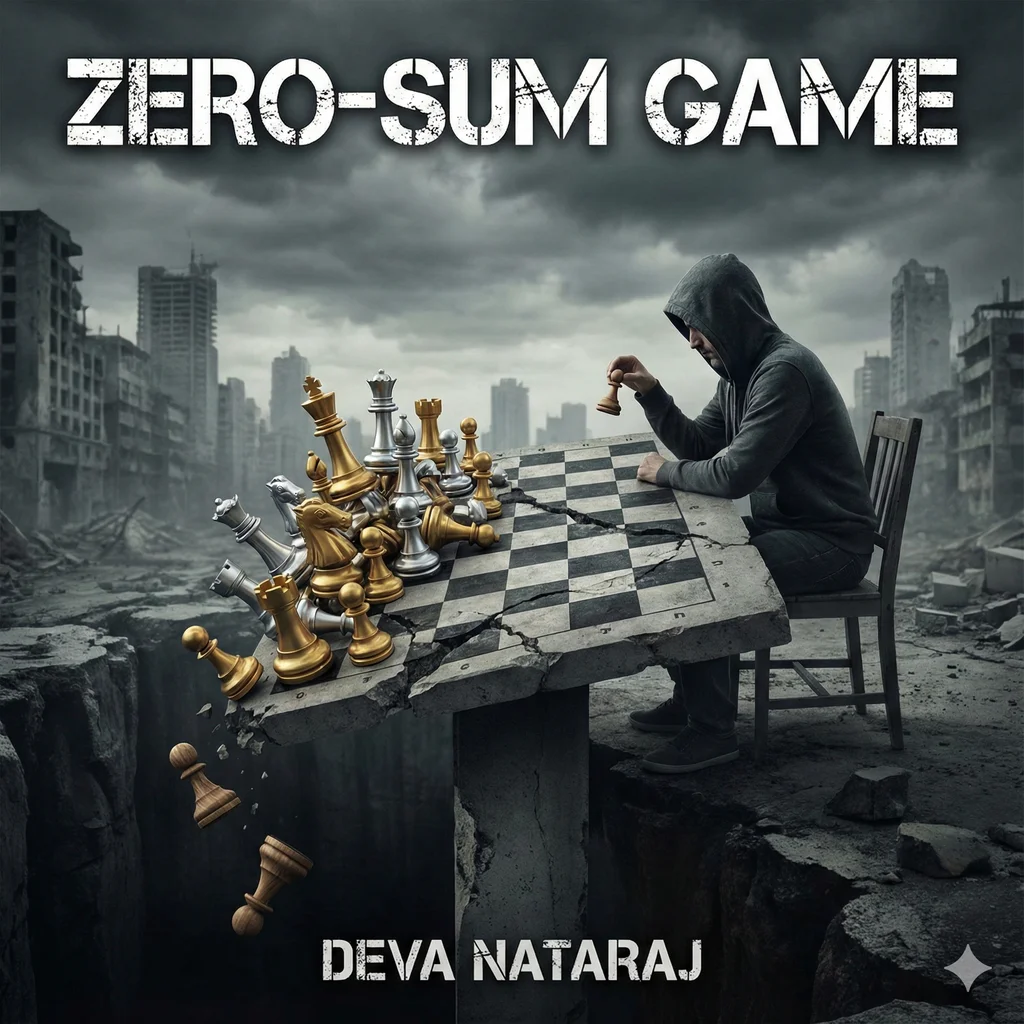
“I was born into a world where the seeds were already picked / Where the rules for the climb were already rigged / Regulation like a wall, ten thousand feet high / While they’re selling us the blueprints for a piece of the sky”. The rigging here is not a cartoon villain. It is structural – permits, policies, rents, a ladder someone climbed and then burned: “They took the ladder up and then they burned the wood / Now they’re judging every move in the neighborhood.” If you have felt that the people judging your effort are standing on ground they never had to earn, the song is not going to tell you that you imagined it.
Nor does it soften the moral of the arrangement: “They say it’s zero-sum, yeah, if I win, you lose / While they’re sitting in the boxes, picking out our shoes”. The phrase zero-sum is the trap’s name. It is the belief that there is a fixed pie and someone has already eaten your slice – and that the only remaining move is to fight the people beside you for the crumbs. The song’s spoken opening compresses the whole grievance to four lines: “The table is full. / The doors are locked. / They tell you it’s a fair fight. / They lied.”
Why does inequality make me so bitter, and is bitterness wrong?
Because inequality is a real injury, and bitterness is what an injury feels like when it has nowhere to go. The song does not call the anger wrong. It calls it energy – and then asks a sharper question: who is that energy currently serving? The second verse lays out the mechanism: “They want me fighting for the scraps on the floor / While they’re reinforcing every single door”. The fight over scraps is the point. As long as your heat is spent on the person next to you on the floor, the doors get reinforced in peace.
Then the song delivers the line the whole track turns on: “But the secret they’re keeping is hidden in plain sight / The game only works if you join in the fight / If you want what they got, then you’re under their thumb / That’s how the sovereign becomes the scum”. Read that last couplet carefully, because it is the diagnosis of bitterness itself. Bitterness is wanting what they have and hating them for having it. The moment your worth is measured by their possessions, you have accepted their scoreboard, and on their scoreboard you were always going to lose. The sovereign becomes the scum not by being poor, but by agreeing to be measured by the rich. (For why a person’s worth was never a number in that ledger at all, see worth beyond achievement.)
How do I stop feeling like a pawn in someone else’s game?
By becoming the observer of the game instead of a piece on the board. The song’s bridge is where the drums drop out and the instruction arrives, plain as breath: “Look at the frustration. / The heat in the chest. / It’s energy. / Don’t give it to them. / Don’t let the anger make you their puppet. / Be the observer. / Watch the game from the mountain top. / They can only rob the man who thinks he’s poor. / I am full. / I am here. / I am the player, not the pawn. / I BREAK THE BOARD.”
Every line is a step, and the order matters. First, feel the heat honestly – do not pretend it is not there. Second, recognize it as energy rather than as a verdict. Third, refuse to hand it over, because anger aimed by someone else is a string, and a person moved by strings is a puppet no matter how loud they are. Fourth, climb – not out of the economy, but out of identification with it – to the place the album keeps returning to: the witness, the one who watches. And from there comes the line worth tattooing on the inside of the skull: “They can only rob the man who thinks he’s poor.”
That is not a denial that theft happens. It is a statement about what can and cannot be stolen. Money can be taken. Opportunity can be fenced off. What cannot be robbed is the fullness of a person who does not locate their fullness in what was taken. The philosophy beneath this music holds that each of us chose to enter this reality carrying a purpose no one else assigned and no one else can confiscate – and that purpose was never denominated in permits or rents. “I am full. / I am here.” Those two sentences are the entire escape from bitterness, because bitterness is the felt sense of being empty and elsewhere.
What do I do instead of fighting for scraps?
Build your own well. The song’s answer to a rigged table is not to overturn it but to stop eating there: “But I see the game, yeah, I see the play / I’m taking my chips and I’m walking away / Zero-sum? No. / I’m the one they can’t show.” Walking away is not surrender. It is the refusal that the whole scheme cannot survive, because “the game only works if you join in the fight.”
The second verse fills in what walking away looks like in a life: “I’m building my own, yeah, I’m digging the well / I’m the only one here with a story to tell / No more checking the odds, no more waiting for a turn / I’m the fire in the forest, let the old structures burn.” Digging a well is slow, unglamorous, and entirely yours. It is the opposite of checking the odds – the opposite of measuring your life against a scoreboard someone else keeps. This is what the album means by sovereignty: not that the fences vanish, but that your attention, your breath, your skills, and your sense of enough are no longer administered from outside. Nothing here is a plan for beating inequality. It is the ground you have to stand on before any plan of yours is really yours.
And the fire in that last line is not arson. It is the fire the album name promises – the unregulated juice, the raw life-force that a bitter person leaks into resentment and a sovereign one channels into building. Suffering, on this reading, is not proof that you were cheated of your purpose. It may be the pressure through which the purpose gets found. (For that reframe of hardship as the forge rather than the verdict, see does suffering have a purpose.)
They can only rob the man who thinks he’s poor
The line to keep is the one spoken from the mountain top: “They can only rob the man who thinks he’s poor.” Is the economy rigged against you? In many of the ways that can be measured, yes, and the song will not insult you by pretending otherwise. The doors are locked. The table was full when you arrived.
But the bitterness is yours, and so is the choice of what to do with the heat in your chest. Give it to them, and you are a pawn – a loud one, perhaps, but still moved by someone else’s hand. Keep it, watch it, and pour it into a well of your own, and the board they built loses its only player. “The board is an illusion. / The debt is a ghost. / Sovereignty starts… / Now.”
Frequently Asked Questions
Is the economy actually rigged against ordinary people?
In many measurable ways, yes – rules, prices, and barriers were set before you arrived, and the song names them plainly: “the rules for the climb were already rigged.” Acknowledging that is not self-pity. It is the honest starting point from which a person can decide what is still theirs to control.
Why does inequality make me bitter, and is that wrong?
Inequality is a real injury, and bitterness is what an injury feels like when its energy has nowhere to go. The song does not call the anger wrong; it calls it “energy” and asks who it is serving. Bitterness becomes a trap only when it means wanting what they have and measuring yourself by their scoreboard.
How do I stop feeling like a pawn in someone else’s game?
Become the observer of the game rather than a piece on the board. The song’s bridge is the practice: feel the heat, recognize it as energy, refuse to hand it over, and “watch the game from the mountain top.” From there you can see that “the game only works if you join in the fight.”
What does “they can only rob the man who thinks he’s poor” mean?
Money and opportunity can be taken, but the fullness of a person who does not locate their worth in what was taken cannot be. Bitterness is the felt sense of being empty and elsewhere; “I am full. / I am here.” is its opposite and its cure.
Which Deva Nataraj song is about economic inequality and feeling like the game is rigged?
“Zero-Sum Game,” the third track of The Unregulated Juice, is written directly about it – a heavy orchestral trap song that names every locked door and then answers with “I am the player, not the pawn. / I BREAK THE BOARD.”