Why Do Visionaries Get Laughed At? Somebody Had to Be First
Visionaries get laughed at because being first is indistinguishable from being wrong right up until the moment it works. The laughter is not malice, mostly; it is the sound a crowd makes when someone steps off the edge of the agreed-upon map. Somebody has to be crazy. Somebody has to be first. And the ones who laugh are usually the ones who quietly believed the sky was a ceiling.
“Sons of the Sun,” the third track of Deva Nataraj’s The Singularity Love Generation, is an explosively energetic acid-rock anthem for exactly those people – the builders and dreamers, and in particular the restless one who landed his rockets tail-first and turned our eyes back to the stars. Its argument is simple: there is no shortage up above. Only oceans. Only love.
Why do people mock the ones who try first?
Because the first attempt at anything looks like a mistake from the outside, and mockery is cheaper than hope. The song opens with the plainest possible statement of the pattern:
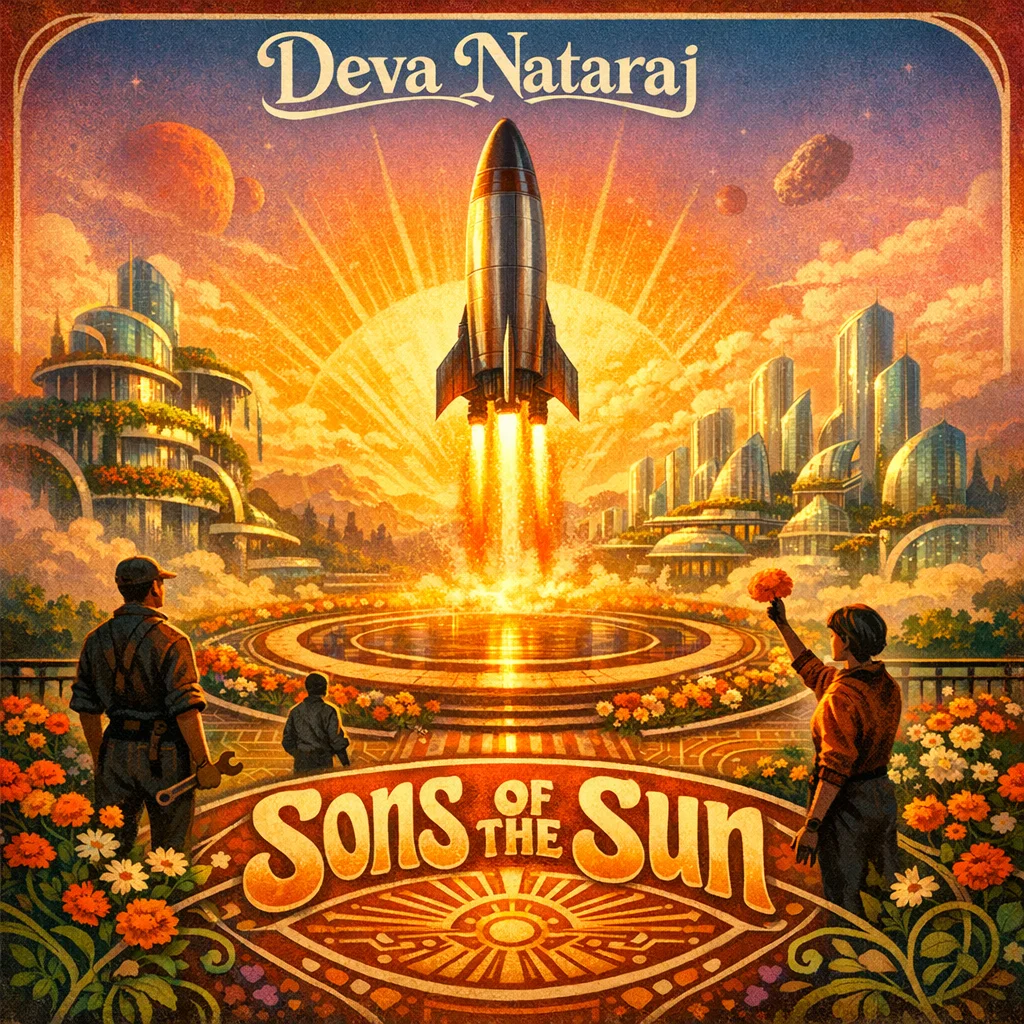
“Somebody had to be crazy / Somebody had to be first / To bottle a piece of the thunder / And aim it past the worst.” Bottling thunder is an absurd ambition until someone does it. And then the second verse names the shape every visionary story takes: “A restless one who wouldn’t listen / When they laughed him off the ground / He landed his fire on its tail again / And turned the whole world around.” The laughter came first. The landing came after. The order is never reversed.
There is a deeper reason for the mockery, and the philosophy behind this album names it. Most people have tied their sense of what is possible to what has already been achieved – and, more painfully, their sense of their own worth to what they have already achieved. Someone who aims past the worst threatens that arrangement. If the sky is not a ceiling, then the ceiling you have been living under was a choice. That is uncomfortable, and laughter is how discomfort protects itself. (For why worth was never supposed to be a scoreboard in the first place, see worth beyond achievement.)
The sound of the song is part of the answer, too. It is the most explosive thing on the album – acid rock at full burn, guitars overdriven, the chorus arriving like ignition. Nothing about it is apologetic. That matters because the laughed-at visionary is usually expected to be humble, to shrink a little, to earn back the room’s approval by seeming embarrassed about the ambition. The song refuses on his behalf. It plays the ambition at full volume and lets the room catch up.
What does it mean to be a son or daughter of the sun?
It means recognizing that you come from an inexhaustible source, and acting like it. The chorus is a declaration of lineage: “We are sons and daughters of the sun / Endless fire, endless run / There’s no shortage up above / Only oceans, only love, only love.” Every scarcity story on Earth – not enough energy, not enough metal, not enough room – is answered by looking up. The song is not being mystical about it. It is being literal: “The asteroids are heavy with the iron / The moon is full of stone / The sun pours down forever / We were never born to be alone.”
The album’s wager is that abundance is not a fantasy but a matter of where you are willing to look and how far you are willing to go. And the last line of that verse is where the tech optimism becomes something warmer. We were never born to be alone. The philosophy underneath this project holds that connection – with each other, with the earth, with existence itself – is the reality that matters, and that we would not have come to a reality where interaction happens if we did not want it. Reaching for the stars is not an escape from each other. It is the widest possible version of finding each other.
There is an older layer under the image as well. The sun has been the first god of nearly every culture that ever looked up, and the tantric root of this project would say that is not a coincidence: existence celebrates itself, and the sun is the most visible form of that celebration – pouring out without keeping accounts. To be a child of the sun is to inherit that posture. You do not hoard the fire. You run with it. Endless fire, endless run is not a boast about stamina. It is a description of what energy does when it stops being afraid of running out.
How do you keep building when everyone says it’s impossible?
By remembering that you are a dreamer with a wrench, not just a dreamer. The song’s bridge refuses to separate the vision from the labor: “Build the towers, build the engines / Build a road of falling light / There’s a red rock waiting for us / And a billion hands tonight.” A red rock waiting. A billion hands. The vision is not a solitary genius on a hill; it is a crowd of ordinary people who decided the laughter did not matter.
The billion hands also answer the loneliness that mockery is designed to produce. Laughter works by isolating – it tells the visionary he is the only one who sees it, and that seeing it alone is proof he is wrong. The song’s counter is arithmetic: a red rock waiting, and a billion hands tonight. The moment you know the hands exist, the laughter loses its main weapon. You are not the only one. You were never the only one. You were just the first one to say it in that particular room.
This is where the song answers the mockery without bitterness. It does not mock back. It builds. And it ends with the plainest self-description on the album: “To the stars / To the stars / However far, however far / We are dreamers with a wrench / We are builders with a star.” That pairing – wrench and star – is the whole ethic. Dreaming without building is what gets laughed at forever. Building without dreaming is how ceilings get installed. The visionary who survives the laughter is the one holding both.
Isn’t it arrogant to aim that high?
It is the opposite of arrogant, because it requires you to be laughed at first. Arrogance protects itself from ridicule. The restless one in the song did not: he wouldn’t listen when they laughed him off the ground, which means he heard the laughter and kept going anyway. That is not pride. That is what the philosophy behind this album calls courage – a love affair with the unknown, and the willingness to carry responsibility for what you attempt.
It also requires something harder than confidence, which is the willingness to be wrong in public and keep going. Every landing the song celebrates was preceded by things that did not land. The restless one did not succeed because he never failed; he succeeded because failing did not send him back to the ground for good. The philosophy behind this album says we did not come here to be afraid, and the fear it means is exactly this one – the fear of being seen to fall. The visionary has simply decided that falling in front of people is a smaller loss than never aiming past the worst.
There is a vulnerability in being first that the laughers never have to feel. You stand up in public with an idea that might not work, and everyone watches to see if it does. The song honors that exposure without pretending it is painless. It just insists on the outcome that matters: the fire landed on its tail. The world turned around. And the sun kept pouring down, forever, as if to say the shortage was never real. (For why letting yourself be seen while you try is the braver path, see the courage to be vulnerable.)
There’s no shortage up above
The line to keep is the one that dissolves every scarcity story at once: “There’s no shortage up above / Only oceans, only love, only love.” Visionaries get laughed at because they see that line before anyone else does, and act on it while it still sounds crazy.
Somebody had to be first. Somebody always does. The song imagines a generation that takes the laughter as a signal it is on the right road, picks up the wrench, and keeps its eyes on the star. Endless fire. Endless run. We were never born to be alone.
Frequently Asked Questions
Why do people laugh at visionaries and big ideas?
Because being first looks identical to being wrong until it works, and mocking is cheaper than hoping. The song lays out the pattern: “A restless one who wouldn’t listen / When they laughed him off the ground / He landed his fire on its tail again / And turned the whole world around.” The laughter always comes before the landing.
What does “sons of the sun” mean?
It means we come from an inexhaustible source and can act accordingly. The chorus declares it: “We are sons and daughters of the sun / Endless fire, endless run / There’s no shortage up above.” The sun, the asteroids, and the moon are the song’s literal answer to every scarcity story.
Who is the “restless one” the song refers to?
The song is a homage to the visionary who landed rockets tail-first and turned the world’s eyes back toward space, though it never names him. It keeps the focus on the pattern he embodies – laughed off the ground, then vindicated – rather than on the person.
How do I stay motivated when everyone says my idea is impossible?
By holding the dream and the tool at the same time. The song ends with “We are dreamers with a wrench / We are builders with a star” – dreaming without building gets laughed at forever, building without dreaming installs ceilings. The visionary who survives the laughter carries both.
Which Deva Nataraj song is about visionaries being laughed at?
“Sons of the Sun,” from The Singularity Love Generation, is written directly about it – an acid-rock anthem for the builders and dreamers who had to be crazy and had to be first, and for the sun that never runs out.