What Happens When the Last Bitcoin Is Mined? A Timeline of Abundance
When the last bitcoin is mined, around the year 2140, the counting is finally done: twenty-one million, not one more, a fixed number that no one can ever inflate again. What happens then, in the song’s imagining, is not a financial event at all. It is the moment what was scarce becomes eternal, and what was money becomes time – and the people standing in the gardens beneath the lanterns are neither rich nor poor, only lovers, only dancers.
“In the Year 2140,” the solemn centerpiece of Deva Nataraj’s The Singularity Love Generation, is a march of decades. Each verse steps forward – 2030, 2045, 2060, 2100, 2140 – and each rises with a new leap of human progress, a male voice leading and female harmonies soaring in the refrains. It is not a prediction. It is the album’s wager, sung out loud.
Why does the last bitcoin matter at all?
Because it is the one appointment on the calendar of the future that is already fixed, and the song uses it as a lantern to walk toward. It arrives in the fifth verse:
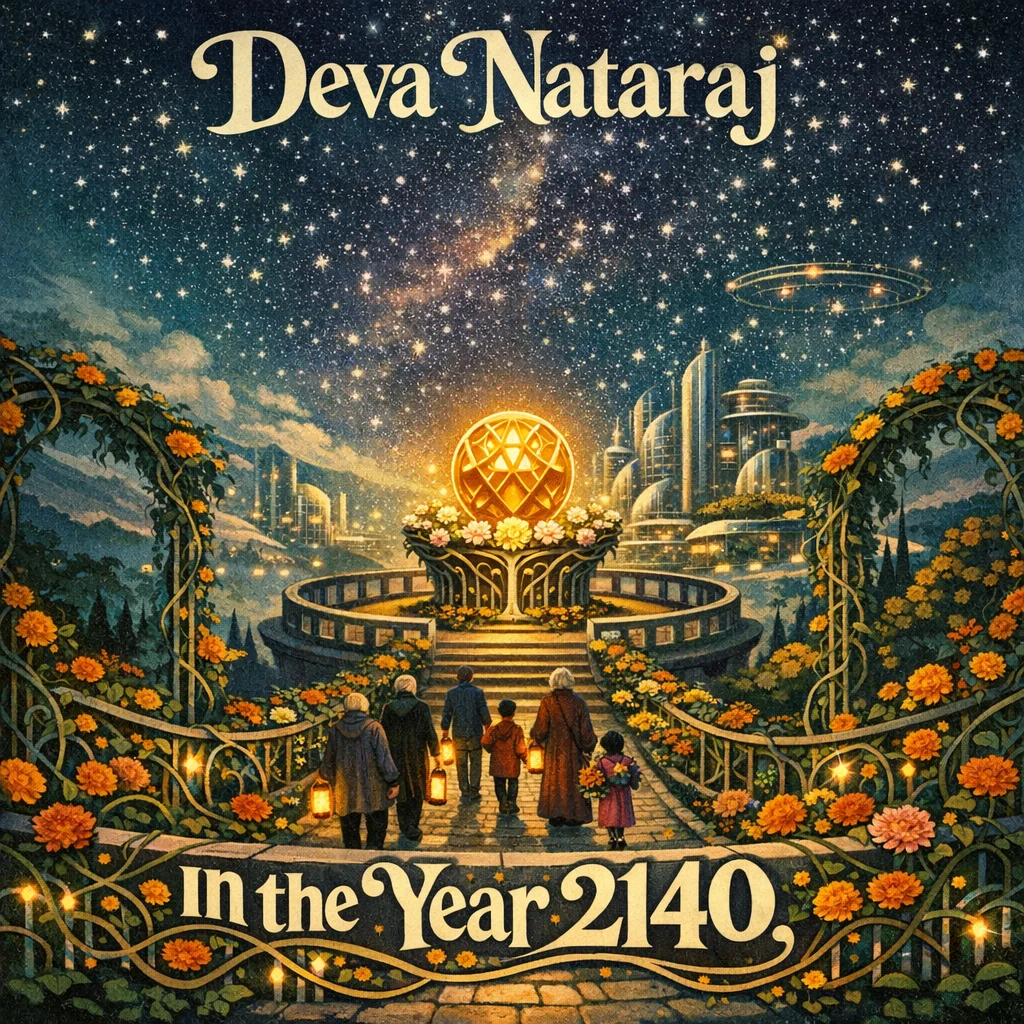
“In the year 2140 / The last satoshi finds its place / The final grain of golden order / Settles softly into grace / Twenty-one million suns completed / Not one feather more to mine / What was scarce is now eternal / What was money is now time.” The song is not interested in price. It is interested in completion – a grain of order settling into grace, a number that can never be added to. What was scarce is now eternal: the scarcity does not vanish, it becomes permanent, and because it is permanent, it stops being a fight.
The philosophy behind this album is careful about money and careful about time. It says only this moment is certainly real, and that a life is measured not by what you accumulated but by whether you were awake for it. A world where money can no longer be printed is, in the song’s imagining, a world where the one thing that was always finite – your hours – is finally honored as the real currency.
The word softly is doing quiet work in that verse. Nothing about the last satoshi is triumphant in the song – no bell, no fanfare. The final grain settles softly into grace, the way a snowfall ends. That is the tone the song wants for the whole idea: not the victory of one kind of money over another, but a long counting coming to rest. A person who has spent a lifetime anxious about running out is being shown a world where the running out is finished, and finished gently.
What does the song imagine happening before 2140?
A staircase of abundance, climbed one decade at a time, each step aimed at ending a specific old sorrow. It begins near enough to touch: “In the year 2030 / If the doubters still have eyes / They will watch the metal shoulders / Lifting cities to the skies / Every hand released from labor / Every mind set free to roam.” Then it steps into medicine: “In the year 2045 / There’s no sickness left to name / We have folded all the proteins / We have tamed the oldest flame.”
The song imagines each leap, and it never claims certainty. If the doubters still have eyes. The album’s wager is that the curve is real, not that the calendar is exact. What the timeline does is give hope a shape – and the shape is not a private fortune but a shared release. Every hand released. Every mind set free. The billion helping hands of 2060 are “Made of steel and made of starlight / Walking gently through the lands” and the children of that decade have only history questions left: “And the children ask their elders / What was hunger? What was fight?” That is the abundance the song is after: not a bigger pile, but a generation for whom hunger and fight are history questions.
The march form matters here. Each verse is a decade, each decade a step, and the male voice that leads is joined by female harmonies that rise in the refrains – as though the future is being sung by more people the further into it the song walks. That is the album’s model of progress: not a lone inventor but a widening choir. By the time the song reaches 2140, the harmonies are carrying it, which is the sound of a generation being joined by the ones who come after.
Is a timeline like this just wishful thinking?
It is a vision, and the song knows the difference between a vision and a forecast. The 2100 verse is openly dreamlike: “We are sailing seas of stars / There are lanterns on the asteroids / There are orchards under Mars / And the old Earth, green and resting / Like a mother watching, proud / As her wild and gifted children / Write their names upon the clouds.” No one in the song is calculating whether this happens on schedule. What matters is the image of Earth green and resting, a mother rather than a mine – abundance that heals its source instead of exhausting it.
The philosophy underneath this project would say the timeline matters less than the wager it carries: that we chose to come here, that the choice had a purpose, and that fear cannot serve it. “We did not come here to be afraid,” it says. A song that dares to imagine 2140 is an act of fearlessness in a culture that mostly imagines collapse. Whether or not the lanterns are lit on the asteroids by 2100, the imagining itself changes what a listener is willing to build toward.
There is also a reason the song chooses to hope out loud rather than hedge. Fear is contagious, but so is a vision, and the philosophy behind this album holds that the culture we build is the one we return to in our next life here. A song that imagines lanterns on the asteroids is planting something for whoever comes back. Whether the dates are right is beside the point; what the dates do is make hope specific enough to work toward.
What are people like when scarcity is over?
Unranked, and singing about the ones who believed. The verse after the last satoshi is the emotional summit of the song: “And the people in the gardens / Neither rich nor poor remain / Only lovers, only dancers / Only sunlight, only rain / And they sing about the old ones / Who believed it could be done / The true love generation / All the ages joined as one.”
Only lovers, only dancers. That is the tantric heart of the whole album – Nataraj, the divine dancer, existence celebrating itself because it exists, not because a target was hit. The song imagines that when the counting is done, what people do with their eternal scarce hours is love and dance and get rained on. And they remember. The old ones who believed it could be done are the flower generation and the builders and everyone in between, sung about by children who never knew hunger. The final verse is a prayer rather than a prediction: “May we stand beneath the lanterns / Every lover, every one / And whatever we have built there / May it shelter, may it free / For the last coin tells the story / Of the love we chose to be.” (For what it means to face the end of a life – or an era – without regret, see a life without regret.)
Neither rich nor poor remain is the line that keeps the vision from being a fantasy of wealth. The song does not imagine everyone getting rich. It imagines the category dissolving – a world where the question of who has more is as strange to the children as the question of what hunger was.
What was money is now time
The line to keep is the hinge of the whole timeline: “What was scarce is now eternal / What was money is now time.” When the last bitcoin is mined, in the song’s imagining, nothing is bought or sold. Something is completed, and the completion frees people to count their wealth in hours and hands.
The song does not promise the year. It promises the direction, and it asks you to stand beneath the lanterns with every lover, every one. The last coin tells the story of the love we chose to be. That story is being written now, one decade at a time.
Frequently Asked Questions
What actually happens when the last bitcoin is mined?
Around 2140 the supply reaches its fixed cap of twenty-one million and no more can ever be created. The song treats this as a moment of completion rather than finance: “Twenty-one million suns completed / Not one feather more to mine / What was scarce is now eternal / What was money is now time.”
Is the song predicting that these things will happen by these dates?
No – it is the album’s wager sung as a vision, not a forecast. The song hedges from the first verse, “If the doubters still have eyes,” and dreams openly by 2100. What it commits to is a direction: abundance that releases hands and heals the Earth rather than exhausting it.
Why does the song say “what was money is now time”?
Because once nothing can be inflated, the only truly finite thing left is your hours. The philosophy behind the album holds that only this moment is certainly real, so a world where scarcity is eternal is a world where time is finally honored as the real currency.
What are people like in the song’s vision of 2140?
Unranked and celebrating. “Neither rich nor poor remain / Only lovers, only dancers / Only sunlight, only rain.” They sing about the old ones who believed it could be done, which makes the whole timeline a story of love remembered rather than wealth accumulated.
Which Deva Nataraj song is about the last bitcoin being mined in 2140?
“In the Year 2140,” the centerpiece of The Singularity Love Generation, is written directly about it – a march through the coming decades that ends when the last satoshi finds its place and the true love generation walks beneath the lanterns.